Resources
Search everything AIDS United publishes — news, policy updates, toolkits, webinars, and community stories — or browse by type below.
The conference will unite hundreds of advocates from across the country to advance federal policies that protect HIV services and health care access
The conference will unite hundreds of advocates from across the country to advance federal policies that protect HIV services and health care access
WASHINGTON, D.C. – October 16, 2026 – AIDS United announced today that registration is open for AIDSWatch 2027, the nation’s largest constituent-driven federal HIV advocacy event, taking place March 15–17, 2027, in Washington, D.C. People living with HIV, community advocates, policy experts, service providers, and allies will gather for AIDSWatch 2027 to connect their experiences with the policies and federal funding decisions that directly affect their communities.
AIDSWatch 2027 will emphasize that effective advocacy does not require being a policy expert. Every advocate has a role to play, whether that’s sharing their personal experiences, learning about the policies affecting their communities, or meeting directly with members of Congress.
“AIDSWatch is a reminder that you do not need to know every policy detail to make a difference,” said Carl Baloney, Jr., President and CEO of AIDS United. “The experiences of people living with and impacted by HIV are essential to this movement. When advocates connect their stories to the policies that shape their lives, they help members of Congress understand what is at stake and why action cannot wait. Every voice matters, and every person deserves the opportunity to be heard.”
At AIDSWatch 2026, nearly 600 advocates from 42 states and territories gathered in Washington, D.C., for three days of intensive policy education and direct engagement with nearly 250 congressional offices. The annual conference gives advocates the opportunity to build their knowledge, connect with peers from across the country, and bring community priorities directly to federal lawmakers.
AIDSWatch 2027 will take place following the 2026 midterm elections, at a pivotal moment for the future of health care and HIV policy in the United States. Advocates will have an opportunity to engage with members of Congress and urge lawmakers to protect Medicaid, preserve funding for HIV services and housing, sustain the President’s Emergency Plan for AIDS Relief (PEPFAR), and ensure that federal funding reaches the programs and communities it is intended to support. Importantly, advocates will share their lived experiences and demand that their rights to bodily autonomy, safety, and dignity are respected.
Through policy education, skills building, and direct congressional engagement, AIDSWatch 2027 will help advocates share their experiences in ways that are meaningful, sustainable, and grounded in their own agency. First-time attendees and longtime organizers alike will be encouraged to bring their expertise and experiences, strengthen their connections, and help shape the policies that affect their communities.
At AIDSWatch, advocates will bring their realities to Capitol Hill and call on Congress to protect the progress made in the fight to end the HIV epidemic and advance policies that promote health, dignity, and justice.
Media are invited to attend and cover select portions of AIDSWatch 2027, including the plenary, Congressional Reception, and Capitol Hill rally. Interviews with advocates, policy leaders, and AIDS United representatives will also be available. Members of the media interested in covering the event or arranging interviews should contact the media representative below.
AIDSWatch 2027
WHEN: March 15–17, 2027
MAIN VENUE: Renaissance Arlington Capital View Hotel, 2800 Potomac Ave., Arlington, VA 22202
REGISTRATION: Registration is now open. Visit aidsunited.org/aidswatch to register and learn more about the conference.
MEDIA CONTACT
Miguel Ayala
Director of Communications
communications@aidsunited.org
202-876-2820
About AIDS United
AIDS United's mission is to end the AIDS epidemic in the United States through strategic grantmaking, capacity building, and policy advocacy. Learn more at aidsunited.org
About AIDSWatch
AIDSWatch is the largest national HIV advocacy event, bringing together hundreds of people living with HIV and their allies to educate members of Congress about the importance of federal funding and sound policies to address the HIV epidemic. AIDSWatch is convened in partnership by AIDS United, the U.S. People Living with HIV Caucus, and the Center for Health Law and Policy Innovation at Harvard Law School.
Three-part series creates space for candid conversations about pleasure, HIV, chemsex, substance use, loneliness and community — while inviting support to keep the conversation going
Three-part series creates space for candid conversations about pleasure, HIV, chemsex, substance use, loneliness and community — while inviting support to keep the conversation going
FOR IMMEDIATE RELEASE
October 14, 2026
Media Contact:
Miguel A. Ayala
Director of Communications, AIDS United
communications@aidsunited.org
202-876-2820
WASHINGTON — AIDS United today launched Mask’d Confessionals, a new three-part podcast by and for Black gay men that creates space for candid, unfiltered conversations about sex, pleasure, HIV, chemsex, substance use, loneliness, relationships, bodily autonomy and community care.
The first episode, “The Pleasure Is All Ours,” is available today, with additional episodes scheduled for October 28 and November 11.
But AIDS United hopes these first three conversations are only the beginning.
Mask’d Confessionals was conceived as a limited series, but AIDS United is using the initial three episodes as a proof of concept for what could become an ongoing platform for Black gay men to tell their own stories, explore issues too often discussed only through the lens of risk or pathology, and help inform advocacy, programs and policy.
AIDS United is inviting listeners, community members and potential philanthropic partners to help build what comes next.
“Black gay men deserve spaces where the conversation doesn’t begin and end with HIV risk,” said Carl Baloney, Jr., President and CEO of AIDS United. “Our lives are about pleasure and relationships, joy and loneliness, family and community, survival and ambition — all of the complexity that makes us human. Mask’d Confessionals creates room for those stories to be told honestly and on our own terms. We hope these first three episodes demonstrate what is possible and inspire partners to help us keep these conversations going.”
The series is hosted by Bishar Jenkins, Senior Manager of Government Relations at AIDS United, and Micah Marquez, founder of Deviant, and produced by Pierre Phipps and Jabari Payne.
Rather than approaching Black gay men primarily as a population to be studied or a set of health outcomes to be improved, Mask’d Confessionals centers lived experience, agency, desire and connection.
“Mask’d Confessionals was curated specifically to get underneath the surface,” said Jenkins. “It was imperative to create a series that gives Black gay men permission to be fully seen. Too often substance use or HIV is discussed as if it is a spectacle or scandal, but rarely do we talk about what our greatest fears and desires are as Black gay men. Understanding these elements of tenderness and care is crucial to developing transformative interventions and public policies that actually serve Black gay men.”
The three-part series explores different dimensions of Black gay men’s lives:
Episode 1: “The Pleasure Is All Ours” — October 14
What does it mean for Black gay men to claim pleasure on our own terms? Jenkins and Marquez open a candid conversation about desire, intimacy, sexual agency, condoms, HIV, connection and what it means to feel truly seen.
Episode 2: “Boys to Men: Coming of Age” — October 28
Who teaches Black gay boys how to become Black gay men? The conversation turns to growing up, masculinity, identity, first experiences, loneliness, family, chosen family and the lessons many Black gay men are left to learn on their own.
Episode 3: “The Business of Sex and Drugs” — November 11
What happens when sex, money, drugs, pleasure, survival and agency intersect? The final episode explores sex work, chemsex, substance use, bodily autonomy, stigma and the complicated choices Black gay men navigate every day.
Mask’d Confessionals grew out of AIDS United’s Pipeline Collaborative, an initiative created to engage Black gay men as impactful messengers around harm reduction, drug safety, sexual health, desire and pleasure.
The project included a paid community advisory board of Black gay men who helped shape the work and contributed their lived experience, expertise and perspectives to its development.
The series also serves as more than a storytelling project. AIDS United is asking Black gay men who engage with Mask’d Confessionals to participate in a community needs assessment that will help the organization better understand what Black gay men want and need from organizations, programs, advocacy and policy.
The goal is to listen — and then use what is learned to help shape future work.
The initial three episodes of Mask’d Confessionals were made possible with funding from Merck and ViiV Healthcare.
AIDS United is now looking toward what could come next.
The organization hopes to secure additional philanthropic support to produce future episodes, broaden the range of voices and experiences represented, create opportunities for in-person and live conversations, and continue building Mask’d Confessionals as a platform where Black gay men can speak openly and authentically about their lives.
Individuals can also directly support the project and AIDS United’s work to create more spaces like it.
“We don’t want the third episode to be the end of this conversation,” Baloney said. “If our community tells us this space matters — and if partners are willing to invest in it — we want to build on it. Supporting Mask’d Confessionals is an investment in Black gay men being able to tell our own stories, ask our own questions and help shape the solutions that affect our lives.”
Watch, listen, participate in the community needs assessment, and support future episodes at:
www.aidsunited.org/maskdconfessionals
The Pipeline Collaborative was developed by AIDS United to build a cohort of Black gay men equipped to serve as impactful messengers on harm reduction, drug safety, sexual health, desire and pleasure. Through community engagement and the leadership of a paid community advisory board, the initiative seeks to affirm the full humanity of Black gay men, challenge narratives rooted solely in risk and pathology, and create resources and conversations grounded in agency, lived experience and community care.
AIDS United’s mission is to end the HIV epidemic in the United States. AIDS United works to ensure that people living with and affected by HIV have access to the prevention, care and support they need by investing in community-based organizations, advancing sound public policy and strengthening the HIV movement. AIDS United centers racial justice and health equity throughout its work.
###
Five years ago, AIDS United began a journey with the Centers for Disease Control and Prevention (CDC), a cooperative agreement with their Partnering and Communicating Together program or PACT. […]
Five years ago, AIDS United began a journey with the Centers for Disease Control and Prevention (CDC), a cooperative agreement with their Partnering and Communicating Together program or PACT.
Building on the successes of the former Act Against AIDS campaign, PACT engaged and expanded networks of national, regional, and local organizations to disseminate the CDC’s Let’s Stop HIV Together campaign.
Through the brand name We Are United, AIDS United partnered with and provided resources to community organizations and influencers to increase awareness about HIV, reduce HIV-related stigma, promote HIV testing and other prevention options, and encourage people living with HIV to begin and stay in treatment. Over the past five years, the We Are United initiative has collaborated with over 100 organizations and reached almost 600,000 people, through in-person, creative digital, and social media engagements.

Year five marks the sunset of the We Are United initiative. This last year has been turbulent, as we not only faced the end of the program but also were met with the erasure of HIV funding across the nation. However, even in the shadow of public health being defunded, our year five partners have shown us the most amazing display of resilience and what it means to “keep pressing” in spite of circumstances.
The We Are United initiative is divided into two categories: in person events and virtual activations. This year we partnered with 27 organizations for activations, from Alabama all the way to California to Puerto Rico and to Mississippi to name a few.
Our virtual activations ranged from podcast spotlights, summer music series highlighting southern DJ’s, social media takeovers, blogs and Historically Black Colleges/Universities (HBCU) Tour digital ambassadors. We worked with podcasts like “Check Please” that create a space for black gay and queer men to engage in discussions around dating in a non-stigmatizing way. We spotlighted work done by Andy Tinoco Mendez (they/he) who is an HIV advocate, community member, poet and artist expanding access to vital resources for queer and trans communities of color in the South. A big impact on our virtual programming this year was our HBCU Digital Ambassadors. Born out of the in-person Spring HBCU Tour, our digital ambassadors were able to tailor the messages of the We Are United initiative to their local college campuses, reaching more than 80,000 views through social media activations.
This year we were able to support 27 in-person events. A returning partner, Aguilar Salud hosted a Community Center Open House which welcomed community members, partners, and local leaders to learn about their bilingual services, including HIV prevention and treatment, primary care, harm reduction, and psychosocial support.
Another partner we have previously collaborated with is Out My Closet. Their Elevated Boutique is a trauma-informed, dignity-centered mobile pop-up that provides under-resourced LGBTQ+ individuals, particularly queer men of color and transgender people, with free, high-quality clothing, shoes, accessories, cosmetics, and hygiene items in a boutique-style setting. What made year five extra special for Out My Closet’s Elevated Boutique is that it went beyond one city, scaling their impact to multiple cities from New York to Miami.

For the first time this year, we partnered with House of Trouble for their Beach Party series. Their Beach Party series creates a safe and affirming space for community members to connect, express themselves freely, and celebrate queer joy in an environment that fosters acceptance and wellbeing. Their all-day events offer music, refreshments, and community engagement activities designed to nurture belonging, reduce stigma, and support holistic health.
For Trans Day of Visibility, we partnered with Under the Umbrella and Trans Men Empowerment, both Texas based organizations that brought people together to feel seen and have a safe space for conversation.

We supported many in-person events during pride season. This year we partnered with CALA and New Orleans Black Pride. CALA hosted a number of PRIDE events that prioritized the Latine community. During their celebration, they held a PRIDE Queen coronation that highlighted HIV advocacy, stigma reduction and even had a special moment for LGBTQ+ mothers and recognized the support they give to their children. CALA's impact reached all the way to Colorado where an attendee reached out to them and wanted to be a part of their PRIDE court as their PRIDE King.
Additionally, New Orleans Black Pride has been a sponsored partner of the We Are United initiative for the last three years of the program. This year, they not only overcame funding challenges but had to alter their event due to weather. They were able to reach 4,700 people through their summit and weekend events. A unique conversation was held at this year’s event, where attendees explored what HIV testing can mean at fun, densely populated community events, particularly when someone receives a positive diagnosis. The discussion highlighted the importance of recognizing the emotional and mental impact of receiving a diagnosis, even in spaces meant for celebration.

I began working at AIDS United in 2020, still reeling from the throes of the COVID-19 pandemic. What I found at AIDS United was a family, not only in the people I worked alongside, but also in the organizations I had the privilege of collaborating with. Seeing the defunding of public health programs, especially HIV prevention and treatment initiatives, is something I never imagined I would witness. Yet, even in moments that can feel overwhelming and uncertain, I remain hopeful in the work that is to come and the collaborations and coalitions that will keep the HIV movement going forward. I know we will remain united and steadfast in ending the HIV epidemic. As we watch this initiative sunset, I ask that we lean into the unfamiliar, collaborate with organizations no matter how big or small, remember that we all share this same beautiful space, and be the change that we not only want to see but need in this world. We send a tremendous amount of thanks to our partners over the past five years.
Sixty-nine thousand, nine hundred and seventy-three. That’s the number of people who died of a drug overdose in the United States in 2025. 69,973 people is enough to fill every […]
Sixty-nine thousand, nine hundred and seventy-three. That’s the number of people who died of a drug overdose in the United States in 2025.
69,973 people is enough to fill every seat in Yankee Stadium and Madison Square Garden at the same time and still have folks get turned away at the door. It is more than the populations of Portland, Maine, Canton, Ohio, or Gary, Indiana. If you break up unintentional injury deaths into its component parts, it’s enough to be the 7th leading cause of death in the US in 2025, and the leading cause of death among those between the ages of 25 and 44.
And yet, we offer begrudging gratitude because those 69,973 overdose deaths were 11,340 deaths fewer than the year before, and almost 38,000 fewer than the year before that. The cause and effect behind that steep decrease in overdose deaths is hard to identify and even harder to explain, but it’s safe to say that the drop was due to a combination of factors including a changing drug supply, increased access to treatment and recovery services, the work of harm reduction organizations, and adaptations by people who use drugs in the ways they use.
I wish that I could say I was confident that overdose deaths would continue to decrease in the coming years, but I can’t. The actions being taken at all levels of government in this country make such optimism very difficult.
At the federal level, the last 18 months have been a masterclass from the Trump administration on how to disrupt and destroy drug user health infrastructure. Roughly half of staff at the Substance Abuse and Mental Health Services Administration have been cut since the start of 2025, while the White House tried (and failed) to slash roughly $2 billion in congressionally appropriated funding and to eliminate the agency in its entirety. The Centers for Disease Control and Prevention have seen their overdose and infectious disease programs gutted by reductions in force grant cancellations, and an ever growing list of what they cannot do or say rooted in fidelity to politics rather than evidence based best practices.
In states and cities across the country, we are seeing a backlash against harm reduction interventions that are proven to prevent transmission of infectious disease, reduce overdose deaths, and get more people with substance use disorders to enter treatment. In its place, we are seeing the resuscitation of the war on drugs playbook that ignited and inflamed the overdose crisis in the first place, with sky high mandatory minimum sentencing for the possession of emerging drugs, abstinence-only treatment that doesn’t show results for people with opioid use disorders, and the institution of ineffective forced substance use disorder treatment at a time when millions who want treatment can’t get it.
There is no silver bullet to ending the overdose epidemic in the United States — no one policy solution that will protect our loved ones or ourselves from being touched by this crisis. But there are policies that will ensure that the overdose crisis never abates and that trap us in an endless loop of avoidable loss and suffering that turns International Overdose Awareness Day into Groundhog Day year after year after year.
If our nation’s drug policies don’t treat people who use drugs like human beings who deserve agency and consideration, we will not end the overdose crisis.
If we insist on an abstinence-only substance use disorder treatment framework that treats addiction to alcohol and marijuana the same way it treats addiction to opioids and stimulants, we will not end the overdose crisis.
If we hamper life-saving research and destroy families by criminalizing drugs to the greatest extent possible and filling our prisons with disproportionately Black, Latino, and people experiencing poverty with substance use disorders, we will not end the overdose crisis.
If we do not address all of the root causes of substance use disorder in this country ranging from untreated mental illness and domestic violence to unaffordable housing and the inability for millions to earn a living wage, we will not end the overdose crisis.
On this International Overdose Awareness Day, it is important that we honor those we have lost to addiction and substance use not just by holding their memory close, but by working to avoid the systemic failures that facilitated their passing. We cannot arrest our way out of the overdose crisis, nor can we compel millions of Americans to sobriety against their will at a time when our treatment centers are already underfunded and overcapacity.
Recovery from substance use disorder has many pathways and our approach to substance use must reflect this. If we create systems that view complete abstinence from all illicit substances as the only acceptable outcome for an interaction between a person who uses drugs and our nation’s healthcare and justice systems, then we will have built a factory whose primary products are relapse, disenfranchisement, and death.
The only path forward is the one that massively increases support for all aspects of our nation’s behavioral health and substance use infrastructure from prevention and treatment to recovery and harm reduction. It’s the path that invests not just in those of us who live with a substance use disorder, but in the communities to which they belong. It’s the path that does not condition a person’s intrinsic value based on whether or not they use drugs, but rather treats their humanity as the only prerequisite to care.
For nine years, the Southern HIV Impact Fund (SHIF) invested in people and organizations working to end HIV in the Southern United States. SHIF was a collaborative grantmaking fund managed […]
For nine years, the Southern HIV Impact Fund (SHIF) invested in people and organizations working to end HIV in the Southern United States. SHIF was a collaborative grantmaking fund managed by AIDS United, created in response to the disproportionate impact of HIV in the South and the inequitable distribution of resources to address it. The Fund provided flexible funding and support to community-based and grassroots organizations working in HIV prevention, care, advocacy, movement building, and leadership development.
The need for this investment was clear. While the South represents 38% of the U.S. population, it accounts for 52% of new HIV diagnoses. These disparities are not accidental. Limited access to health care, underfunded public health systems, lack of Medicaid expansion, poverty, stigma, racism, and political environments that threaten the sustainability of HIV programs all shape health outcomes across the region. SHIF helped address these systemic barriers by putting resources directly into the hands of communities most impacted by HIV.
Over its eight years of grantmaking, SHIF invested more than $15.3 million in funding and technical support across 105 organizations. Grantees reached more than 500,000 people through prevention, linkage to care, education, and mobilization efforts. As the Fund ended, AIDS United launched a Southern roadshow and listening process to reflect on what communities had accomplished, understand the challenges they face today, and identify what is needed next.
To reflect on SHIF’s legacy, I spoke with former SHIF Program Manager Clifford Castlebery and AIDS United Senior Manager of Impact and Evaluation Vienna Mbagaya. Both brought years of experience working alongside SHIF grantees and communities across the South. Our conversation focused on what they learned from the organizations they supported, the lessons that should guide future investments, and what comes next for communities continuing the fight to end HIV.
One of the clearest lessons from SHIF was that Southern communities did not lack ideas or solutions, they lacked resources.
Clifford emphasized that communities across the South already understand what is needed to end the HIV epidemic. The challenge is having enough funding and political support to put those solutions into practice. SHIF grantees demonstrated remarkable resilience and creativity, developing responses to local needs while navigating political attacks and limited resources.
Vienna similarly emphasized that progress depends on strengthening the community organizations already doing the work. Funding alone was not enough. SHIF paired financial resources with technical assistance, capacity building, coalition building, and relationships that helped organizations adapt as circumstances changed.
One important lesson was the value of investing in organizations themselves, not only individual programs. Flexible, general operating funding helped organizations maintain continuity and respond quickly during crises without waiting for additional paperwork or approvals. Technical assistance was most effective when it responded directly to what grantees identified as their needs.
SHIF also reinforced that community leadership and civic engagement are essential to health outcomes. In a region where voter suppression, political hostility, and stigma can make participation more difficult, supporting organizations’ ability to build power and engage their communities was part of advancing HIV prevention and care.
The final years of SHIF demonstrated how important this flexible, community-centered approach was.
Vienna reflected on how grantees “held the line” during the Fund’s final grant year as policy hostility, backlash against DEI and LGBTQ-inclusive work, and unpredictable funding created new pressures. Organizations faced staffing changes, shortened timelines, and difficult decisions about participant safety and confidentiality.
Yet they continued showing up. Grantees protected affirming spaces, maintained prevention and care linkage, adapted outreach strategies, strengthened local partnerships, and found new ways to reach people safely.
For Clifford, supporting HBCUs and Black Greek Letter Organizations was a particularly meaningful part of his work. As an alumnus of Xavier University of Louisiana and Texas Southern University, he described supporting these institutions as a “full-circle moment” and an opportunity to invest back into places that had invested in him.
These experiences illustrate a larger lesson: when communities are trusted and resourced, they can continue leading even in difficult political and social environments.
SHIF’s legacy extends beyond its grants. In partnership with the Gilead COMPASS Initiative, related investments across the South reached more than $133 million, reaching more than 651,000 people and supporting 1,645 grants to 498 organizations.
The Southern roadshow, titled “The State of the South Tour”, provided another opportunity to understand what that investment made possible and what communities need moving forward. Ten listening sessions — four in-person sessions across led by Black South Rising in Texas, South Carolina, Georgia, and Florida and six virtual sessions — engaged hundreds of community stakeholders. The conversations examined how political and social systems shape health and explored how Southern communities can continue to build, thrive, and heal.
Looking ahead, Clifford emphasized that the South needs more than additional funding. Communities need “political power to push back against harmful policies”, elected officials committed to racial justice and health equity, and meaningful opportunities for people most affected by HIV to shape decisions — not simply serve as representatives of statistics.
Vienna identified several priorities emerging from the listening sessions: sustain coalition infrastructure, support community-led data collection and storytelling, strengthen local governance and civic engagement, provide flexible funding that recognizes the connections between housing, food, harm reduction, and HIV care, support trusted messengers, and build leadership pipelines rooted in mentorship and lived experience.
The future of HIV prevention and care in the South will depend on carrying these lessons forward. SHIF demonstrated what is possible when funders invest in grassroots organizations, trust communities to lead, and provide the resources and support needed to turn local knowledge into action.
The political landscape may continue to change, but Southern communities have repeatedly shown their ability to adapt, organize, and hold the line. SHIF’s greatest legacy may be the reminder that when communities are resourced and trusted to lead, progress remains possible.
Special thanks to all the Southern HIV Impact Fund grantees who made this work possible.
For more information about the Southern HIV Impact Fund and its listening sessions, check out this link. Additionally, if you want to know how you can help in the fight against the HIV epidemic, visit Let’s Stop HIV Together.
Historically Black Colleges and Universities (HBCUs) have stood the test of time. At their inception in 1837, HBCUs began as a place for Black Americans to learn in a culturally […]
Historically Black Colleges and Universities (HBCUs) have stood the test of time. At their inception in 1837, HBCUs began as a place for Black Americans to learn in a culturally relevant and safe space. Since then, they have led the way in higher education. At present, HBCUs function also as a place to have open and honest conversations around sexual wellness. Specifically, HIV prevention and treatment.
The We Are United initiative at AIDS United began their Spring HBCU tour in 2025 to prioritize Black students and conversations regarding HIV prevention, treatment and stigma reduction. Despite funding challenges, the spring tour was able to proceed for a second year. For the second year of the HBCU Spring Tour, we partnered with five schools and four digital ambassadors. Adding a digital component allowed our message to reach almost 100 thousand students on social media with culturally tailored posts that they could see themselves in.
Once the tour concluded, I was able to sit down with Destinee Kerr, Xavier alumni, social media extraordinaire and HBCU Friendsgiving founder, and Dr. Grace Loudd and Dr. Dominique Guinn, both professors at Texas Southern University. Beginning our conversation, I asked Destinee, Dr. Loudd and Dr. Grace about their journey to HBCU’s. Destinee began our conversation with how she started at Xavier University and received much more than just an education.
“As a proud Xavier University of Louisiana alumna, choosing an HBCU was an easy decision because I wanted to be in an environment where excellence, culture, and community were celebrated every day. As a first-generation college graduate, I knew my college journey would set the tone for generations after me. Inspired by my sister’s dream of attending an HBCU, I wanted to continue that legacy while building one of my own. At Xavier, I found more than an education—I found a family. I was surrounded by people who looked like me, believed in me, challenged me, and encouraged me to lead with purpose. That experience continues to shape the way I serve my community today.”
Additionally, Dr. Guinn’s first interaction with HBCUs was also as a first-generation college student when she attended an HBCU for her master’s program. Through her experiences, she discusses the pride that she held while being on an HBCU campus.
“It’s beautiful to know that although HBCUs make up only about 3% of America’s colleges and universities, they produce approximately 16% of Black college graduates, around 40% of Black engineers, and nearly 80% of Black judges. When you look at those numbers, you truly see the impact and importance of HBCUs.”
During our discussions, I realized that exposure and awareness of the existence of HBCUs isn’t a universal experience for Black students. Dr. Loudd alludes to that in her conversation when she first started working at Texas Southern University (TSU).
“The first time I visited the TSU campus, it felt as if I had been let in on a big secret. I saw students who looked like me and later learned that many of them shared backgrounds like my own as a student, trying to find an educational pathway despite social and economic barriers that can make higher education feel out of reach. In sharing my initial experience with my family, I learned that my grandfather had attended a tailoring program offered at TSU many years earlier. He was always an advocate for education and made sure all his children obtained a high school education. Learning that my grandfather once walked the TSU campus made my experience feel deeply personal. Discovering that connection made me feel as though TSU had been part of my family’s story long before it became part of mine. In many ways, it felt like TSU chose me.”
When thinking of HIV prevention and treatment, it is important to empower students and educate them in ways that allow them to have open and honest conversations regarding their sexual wellness. Dr. Loudd continued this conversation when she highlighted the stigma in communities that students come from that do not allow them to have conversations around sexual wellness.
“Having these conversations on HBCU campuses is especially important because many of the students we serve come from communities where conversations about sexuality have historically been influenced by stigma, cultural expectations, limited access to healthcare, or misinformation. At the same time, the majority of HBCUs are in the U.S. South, a region that continues to experience significant HIV-related health disparities driven by longstanding inequities in healthcare access, stigma, and social determinants of health. HBCUs are uniquely positioned to close this gap. Because students often view these institutions as trusted communities, campuses have a unique opportunity to normalize conversations about sexual wellness, increase access to prevention and testing services, and empower students to make informed decisions about their health without fear or shame.”
Destinee adds that it is important to continue to have conversations around HIV prevention and sexual wellness because,
“It’s important having these conversations on HBCU campuses because education is one of the most powerful tools we have in preventing HIV and promoting overall sexual wellness. HBCUs have a long history of producing leaders, and that includes leading conversations that promote healthier, stronger communities.”
Additionally, when looking at the data when it comes to HIV prevention and treatment, Dr. Guinn reminds us that,
“…Many disease states disproportionately affect African Americans. Then think about what an HBCU campus really is. It’s a city within a city. In that unique community, most of the residents are between the ages of 18 and 24, a stage of life where sexual and reproductive health are incredibly important. That’s exactly why these conversations belong on HBCU campuses.”
Understanding that these conversations are integral to the students attending HBCUs, the Spring HBCU tour prioritized National HIV Testing Day (June 27th). Dr. Guinn shared that she discusses and educates students on National HIV Testing Day, World AIDS Day and National Women and Girls HIV/AIDS Awareness Day. She takes each of these days as an additional moment and opportunity to educate, reduce stigma, and encourage healthy conversations.
Dr. Loudd encourages students to think about HIV testing beyond a single awareness event and make it more a part of an ongoing conversation about overall wellness. Specifically, Dr. Loudd mentions that,
“Throughout the year, we intentionally connect HIV awareness to broader conversations about wellness, relationships, prevention, and healthcare access so that testing becomes part of routine health maintenance rather than something associated only with risk or crisis. My goal has always been to reduce fear, normalize HIV testing as a routine part of preventive healthcare, and help students understand that knowing their status is an act of self-care, not something to be ashamed of.”
In conjunction with in-person events and educational efforts, Destinee uses her social media platform to provide resources to her peers regarding HIV testing, encouraging people to know their status and helping to lift up HIV prevention resources available to students and the community. She believes using digital platforms is a powerful tool in reducing stigma and reminding young adults that getting tested is a normal and important aspect of their overall health.
Through my own experience of working with HBCU campuses there have always been so many moments that stand out and have a lasting impact. I asked the group about memories that had a lasting impact on them. Destinee describes,
“One of my favorite memories was seeing students genuinely engage in conversations about HIV prevention and sexual wellness without fear or judgment. What stood out most wasn’t just the information being shared—it was watching students ask questions, support one another, and realize that taking care of their health is something to be proud of, not something to hide. That experience reminded me that education goes beyond handing out resources. It’s about creating safe spaces where people feel seen, heard, and empowered to make informed decisions. Working with HBCUs reinforced for me that when we lead with community, culture, and compassion, we can reduce stigma and encourage more students to prioritize their health. That’s the lasting impact I hope to continue making wherever I serve.”
Dr. Guinn and Dr. Loudd have had similar impactful moments when watching students become advocates for one another and leading the conversations. Dr. Guinn describes a time when her students in her Human Sexuality class held an HIV testing event.
“What made it especially memorable. During our practice sessions, I noticed that the young men seemed especially engaged and committed. So, I made a last-minute decision. The women would focus on promoting the event, while the men would facilitate the curriculum. I’ve been teaching Human Sexuality at Texas Southern University for the past 10 years, and I have never seen anyone present that curriculum the way those young men did. They absolutely nailed it, and I was incredibly proud of them.
At the forefront of continuing this work is the need for funding. In addition to more funds, Dr. Loudd mentions having culturally responsive programming, dedicated personnel and long-term partnerships with leaders in the HIV prevention and sexual wellness space. Most importantly, to continue this work students must remain at the center in curating these spaces and conversations. Dr. Guinn reminds us that conversations regarding HIV prevention will continue, but we must remain ready with sustainable funding to meet students where they are once, they are ready to take the next step in their wellness journeys.
Through the past two years we have reached almost 800 students at events that ranged from fashion shows to spring fests on 8 HBCU campuses. Additionally, with our four HBCU ambassadors we reached 74,000 students through social media content that focused on a day-in-the-life of getting an HIV testing. Looking towards the future Destinee explains that,
“My hope is that we continue creating environments where students feel comfortable asking questions, getting tested, seeking treatment when needed, and supporting one another. When we invest in students’ health, we’re investing in future leaders who will carry these conversations far beyond campus.”
The future also holds a lot of competing priorities for students, Dr. Guinn touches on how today’s students have been faced with vaping, opioid and fentanyl crisis along with other health issues. For students, HIV may not always be in the forefront of their minds which empowers change makers like Dr. Guinn, Destinee and Dr. Loudd to continue decreasing stigma and reminding students to not be afraid and instead, educate themselves to be the most prepared while they navigate the world. Dr. Loudd shares with us the importance of prioritizing HBCU campuses and young adults in decreasing HIV stigma and encouraging sexual wellness conversations.
“I believe the future of the HIV movement will increasingly recognize HBCUs not simply as institutions of higher education, but as national leaders in developing culturally responsive, sustainable strategies that improve health outcomes for communities disproportionately affected by health inequities. What gives me hope is that administrative leadership and today’s students are increasingly willing to have conversations that previous generations often avoided. When institutions and their leaders are willing to listen, partner with students, and invest in culturally responsive approaches, I believe HBCUs will continue leading the way in transforming not only HIV prevention but also how we think about student health and well-being more broadly.”
Although I never had the pleasure of attending an HBCU, I have had the honor of working with students, faculty and staff who have put their all in leading the next generation forward. Through our collaboration over the last two years, we have attended amazing campuses, reaching students in-person and through social media. Although funding has shifted, and we will not be doing a year three of the HBCU spring tour, our commitment to educating college students on sexual wellness and HIV testing has not stopped. Make sure to sign up for AIDS United’s newsletter and stop by Together.TakeMeHome.org to order free HIV tests along with other STI testing resources.
Special thanks to our collaborators at Grambling State University, Miles College, Morgan State University, Stillman College, Texas Southern University and Xavier University. Along with our Digital Ambassadors, Destinee Kerr, Landon Mumphrey, Calin King and Ma’at Firven.
By Carl Baloney, Jr., President and CEO, AIDS United When I stepped into the role of President and CEO of AIDS United, I knew I would be leading an organization […]
By Carl Baloney, Jr., President and CEO, AIDS United
When I stepped into the role of President and CEO of AIDS United, I knew I would be leading an organization with a powerful legacy. AIDS United has never been just one organization in one city, or one voice in one policy fight. It is a national organization with a local heartbeat — rooted in the people, providers, advocates, organizers, grantees, and community leaders who have carried the HIV movement forward for decades.
One year later, I feel the weight—and the privilege—of that responsibility more deeply than ever.
This first year has been a year of honoring those who built this movement before us, of asking what AIDS United must become for the fights ahead, of remembering how far we have come and refusing to ignore how quickly progress can be threatened. It has been a year of urgency, of deep gratitude, renewed purpose, and clear-eyed concern.
And more than anything, it has reminded me that the HIV movement has always been strongest when we move together.
Last fall, our Legacy Gala offered one of the clearest reminders of that truth. It was more than a beautiful evening. It was a gathering of generations — people who had been in this fight from the earliest days of the epidemic, people who had built organizations out of grief and necessity, people who had fought for research, treatment, housing, prevention, dignity, and justice when too many others looked away.
But it was also a gathering of the future. In that room were younger advocates, new partners, public health leaders, donors, policymakers, and community members who understand that HIV is not only a medical issue. HIV is a prism through which we can see so many of the structural failures that still shape people’s lives: racism, poverty, housing instability, criminalization, stigma, unequal access to care, and the political choices that determine who gets to live with safety and dignity.
That night reminded me that legacy is not something we simply celebrate. Legacy is something we inherit, protect, and expand.
That same spirit carried us into AIDSWatch this past March. AIDSWatch has always been one of the most important gatherings in our movement because it brings the voices of people living with and impacted by HIV directly to the halls of power. This year, that felt especially urgent. Advocates came from across the country to tell the truth about what is happening in their communities. They talked about access to treatment, PrEP, and housing, and the programs that make survival possible.
AIDSWatch is powerful because it refuses to let policy remain abstract. A budget cut is not just a line item. A delayed grant is not just a bureaucratic inconvenience. A restriction on prevention services is not just a policy debate. These decisions shape whether someone can see a doctor, stay housed, afford medication, access PrEP, or remain connected to care.
At AIDSWatch, we saw once again that our community does not need to be spoken for. Our community needs to be heard.
That has been one of the defining lessons of my first year: AIDS United’s role is not only to advocate. It is to amplify. It is to connect. It is to create platforms where the people closest to the impact are closest to the decision-making. Our job is to make sure policymakers, funders, media, and the broader public understand what our communities already know: HIV did not go away. Neither did we.
As I look toward the future of AIDS United, I am thinking a great deal about our collective power—how we protect it, how we build it, and how we share it. My vision for AIDS United is to become the country’s most connected HIV organization, one that actively works to end the epidemic by addressing the underlying weaknesses in our society and public health response. We will achieve this by centering our approach through innovation, updated messaging, and power building at the local level.
We are entering a period of significant transition. Many of the congressional champions who have stood with the HIV movement for years are retiring or preparing to leave public office after the next election. Their departure means we cannot assume that the next Congress will carry the same institutional memory or the same relationships.
That is not a reason to retreat. It is a call to organize.
We must capitalize on the opportunity to educate a new generation of policymakers, build relationships with them and make sure HIV is not treated as a niche issue, but as a central question of health equity, racial justice, LGBTQ+ justice, economic security, and human rights. We must reach people who have not yet seen themselves as part of this fight, and invite them into this movement.
This means expanding the base of support for AIDS United and for the HIV movement more broadly. Development is movement-building: expanding the community of people who understand what is at stake, are willing to act, and are ready to invest in the resources needed to sustain and grow this work. We need more individual donors, corporate partners, and foundations to understand that advocacy, communications, leadership development, and movement infrastructure are not extras; they are essential. And we need the general public to understand that the fight against HIV is not over — and that their support can help determine what comes next.
In the years ahead, AIDS United will be more visible. You will see us in more rooms, at more convenings, in more communities, and in more conversations. We will continue showing up in Washington, but we will also show up beyond Washington. Because the HIV movement lives in community-based organizations, clinics, harm reduction programs, state coalitions, peer networks, and local leaders who are doing the work every day, often with too few resources and too little recognition.
We will also expand how we communicate. That means strengthening our presence on platforms like TikTok and YouTube, not because every organization needs to chase every trend, but because we need to meet people where they are. Younger audiences are getting information differently. Communities are organizing differently. Stories are spreading differently. If we want to shape the public conversation about HIV, health equity, stigma, and justice, we must be present in the spaces where those conversations are happening.
But visibility cannot only mean putting AIDS United’s name in more places. It must mean lifting up more voices.
In the next chapter of our work, we will be even more intentional about centering people living with HIV, Black and Latine communities, transgender and gender-expansive people, people who use drugs, people impacted by criminalization, people navigating housing insecurity, and people in the South and other regions too often underfunded and overlooked. We will tell more stories from the front lines. We will create more opportunities for impacted people to speak directly to the public, the press, funders, and policymakers.
We will continue to defend evidence-based public health, because facts, science, and community leadership remain the foundation of ending the HIV epidemic.
The most powerful voice in this movement has never been any one CEO, organization, or institution. The most powerful voice has always been the collective voice of people demanding to live.
My first-year leading AIDS United has confirmed what I have always believed: our movement is resilient, but resilience alone is not enough. Communities should not have to survive on resilience. They deserve resources. They deserve sound policy. They deserve quality care. They deserve safety. They deserve leaders who listen to them. They deserve a public that refuses to look away.
I am proud of what AIDS United has done this year. But I am even more focused on what comes next.
The next year will require courage and discipline. It will require new partnerships, new resources, new messengers, and new strategies. It will require us to honor the legacy of this movement not by standing still, but by moving forward with urgency and purpose.
AIDS United’s legacy is not measured only by what previous generations built. It will be measured by what we choose to build next.
Together, we will carry that legacy forward.
To our grantees, partners, advocates, donors, board members, staff, and community: thank you for trusting me this first year. Thank you for challenging me, teaching me, and walking alongside me. Thank you for reminding me every day that this work is not only about institutions. It is about people. It is about love. It is about justice. It is about the future we are still building together.
And now, we need you in that future.
If you believe in this work, stand with AIDS United. Make a gift that helps sustain advocacy, leadership development, communications, and community power. Raise your voice with us when programs are threatened, when stigma resurfaces, and when people living with and vulnerable to HIV are pushed to the margins. Share our stories. Join our campaigns. Bring someone new into this movement.
The next chapter of the HIV movement will not be written by one organization or one leader. It will be written by all of us — advocates, providers, funders, policymakers, storytellers, organizers, and community members who refuse to let progress slip away.
AIDS United’s legacy is not measured only by what previous generations built. It will be measured by what we choose to build next.
Let’s build it together.
###
Support AIDS United with a donation HERE
For decades, June has arrived clad in rainbow banners and glittering parades marked by dozens of corporate logos promoting equality and inclusion. But, beneath the commercialized surface, the original spirit […]
For decades, June has arrived clad in rainbow banners and glittering parades marked by dozens of corporate logos promoting equality and inclusion. But, beneath the commercialized surface, the original spirit of Pride has always been resistance, survival, and revolution. In 2026, as LGBTQ+ communities face an unrelenting wave of legislative attacks on healthcare, major corporations who once publicly exclaimed “Pride is for Everyone” have begun to roll-back support for fear of political or legal repercussions from the Trump administration following a slew of executive actions targeting companies promoting diversity, equity, and inclusion. As funding opportunities for LGBTQ+ communities have shifted and corporate partners are stepping back, grassroots organizers are finding themselves at a crossroads. Yet, on the ground the story is not one of defeat. Backed by flexible funding from AIDS United’s We Are United Initiative, a project of the Conexiones Positivas Fund, two of our grantee partners are demonstrating that when corporations pull back, community networks step up. Through radical creativity and an unshakeable commitment to their communities, these organizations are proving that when times are tough, we save ourselves.
To understand the resilience of modern LGBTQ+ organizing, we must look to our history. Long before Pride became a month-long marketing campaign, it was forged in the fire by activists resisting state violence and pushing against exclusion. In May 1959, at Cooper Do-nuts in Los Angeles, trans women, drag performers, and street youth fought back against arbitrary police arrests. Seven years later, in August 1966, it was these same communities who fought back against police harassment at Compton’s Cafeteria in San Francisco’s Tenderloin district, marking first recorded collective acts of transgender resistance in US history.
When the Stonewall Riots erupted in Greenwich Village in June 1969, it was transgender women of color like Sylvia Rivera and Marsha P. Johnson who stood on the front lines. They didn’t just fight for the right to exist in public spaces, they made every effort to meet the fundamental needs of our communities by founding Street Transvestite Action Revolutionaries (STAR) to provide housing, food, and protection for unhoused trans and queer youth. This legacy of self-preservation deepened during the height of the HIV/AIDS in the 1980s and 1990s when the federal government and mainstream medical institutions ignored the pleas from hundreds of thousands in our communities for aid. Organizations like ACT UP revolutionized public health and pioneered treatment advocacy, established buyers’ clubs to distribute underground medications, and set up the nation’s first needle exchange programs. Our communities have always survived by building our own systems of care when the state and corporate structures failed us.
In 2026, this battle for self-determination remains ongoing. For Nikkie Alexander-Tumblin, the executive director of NOLA Black Pride in Louisiana, the corporate and state retreat has impacted their ability to deliver community programming. “It actually has impacted us significantly,” Nikkie shares. “We saw a big drop in our sponsorships. A lot of entities were doing it because it was a ‘have to’ under DEI, and now that they don’t have to, they completely stopped. We had some just totally ignore us, which is sad because they had been with us for a while.”
In addition to funding being cut, corporate sponsors are increasingly offering “closeted” support, demanding that their logos be kept off event flyers or requesting that trans-specific language be removed entirely to avoid political backlash. “It’s really just insane when you think about it,” Nikki says. “We need the support to push the mission forward. But where do you say, ‘Hey, if you aren’t able to stand with us and be proud about it, then we can’t take it’? It puts small, Black-led, trans-led organizations in an incredibly tough spot.”
When corporate partners asked them to exclude trans-focused programming to secure funding, NOLA Black Pride drew a hard line and Nikki, and her team chose integrity over compromise. “We’ve had entities ask us to not include anything that’s like trans-focused and stuff like that,” Nikkie shared. “So we just decided, yeah, that’s not going to work for us because all of our work includes everybody.” By standing firm and refusing to compromise, NOLA Black Pride turned toward the community it had always supported and asked partners to step up and ensure they were able to continue their important work. “This year, a lot of community organizations stepped up to help us push through,” Nikki reflects. “I have never allowed a corporation to tell me how we are going to celebrate. I have never walked away from a good amount of money saying, ‘No, this is not who we are.’ Pride is about community. It started as a riot, and in a way, we are rioting still–but in our own way. Even if we were just dancing in the middle of the street, our people would be happy because we are together. We never really needed corporate validation. We just needed each other.”
Like NOLA Black Pride, Michael Narain of Out My Closet has faced similar requests from corporate donors seeking tax write-offs while publicly distancing themselves from the communities they fund. “They want discretion–no logos, no public mentions,” Michael notes. This rising requirement of corporate anonymity sends a damaging message to LGBTQ+ communities who have spent decades fighting to step out of the closet. As the team has seen diminishing returns from long-time corporate supporters, they have called on local nightlife partners to help host community raffles and fundraising events to sustain their programming. For Michael, Pride cannot be bought or sold, it’s a practice of restoring dignity, instilling hope, affirming worth, and securing health and safety for LGBTQ+ people.
Through the We Are United Initiative, AIDS United remains committed to fueling the visions of our partners. We are honored to stand alongside NOLA Black Pride, Out My Closet, and the thousands of other LGBTQ+-led and serving organizations across the country who are reclaiming the true meaning of Pride: unconditional community care, resistance, and collective joy.
DeOnyae-Dior Valentina (she/her/ella) is a nationally recognized trans justice advocate, HIV policy strategist, and emerging legal professional whose work centers the intersection of lived experience, legislative reform, and community-led systems […]
DeOnyae-Dior Valentina (she/her/ella) is a nationally recognized trans justice advocate, HIV policy strategist, and emerging legal professional whose work centers the intersection of lived experience, legislative reform, and community-led systems change.
I had the incredible opportunity to participate in AIDSWatch 2026, and I’m still reflecting on everything the experience represented. For me, AIDSWatch was a chance to engage at every level of advocacy, from shaping national conversations and equipping community advocates with tools, to bringing those conversations directly to policymakers on Capitol Hill.
I began the week as a panelist during the opening plenary, “We Keep Us Safe: Impacted Communities in Trump 2.0.” Alongside an incredible group of advocates and leaders, we discussed the realities many of our communities are navigating during a period of increasing attacks on healthcare access, LGBTQ+ rights, immigrant communities, and economic stability.
As a young Black and Brown transgender woman living with HIV from Indiana, I spoke about what it means to experience policy as something that directly impacts our ability to access care, remain housed, feel safe, and plan for the future. I discussed the fear many communities are experiencing, specifically the fear rooted in systems. The fear of losing healthcare coverage. The fear of administrative barriers interrupting care. The fear of engaging with institutions that are supposed to support us.
One of the points I shared was that policy decisions do not remain in legislative chambers or agency offices. Policy doesn’t stay in Washington; it lands in our bodies.
It was truly an honor to share the stage with Ronnie Taylor and Omar Martinez Gonzalez, whose expertise and advocacy continue to strengthen our movements. I am also incredibly thankful to our moderator, Gabriel San Emeterio, for guiding a thoughtful and powerful discussion that centered the realities our communities are facing while keeping us grounded in solutions.
Later in the day, I had the opportunity to facilitate the launch of my project, Trans Futures: Centering Trans Youth Voices in HIV Policy, a national storybank and advocacy toolkit developed through AIDS United’s Transgender Leadership Initiative. The project was designed to translate the lived experiences of transgender and gender-expansive youth into policy-relevant insights that can inform advocacy, public health planning, and legislative action through five core pillars: lived-experience leadership, ethical narrative practices, structural pattern recognition, policy translation, and community-centered accountability.
The workshop explored why storytelling remains one of the most powerful tools we have for policy change, not because stories replace data, but because they provide the human context behind statistics. As I shared during the presentation, statistics alone cannot explain how systems fail in real time, how administrative barriers interrupt care, or how fear shapes healthcare decisions. Stories help us understand what policy outcomes actually look like in people’s lives.
Through the Trans Futures project, stories were collected from transgender and gender-expansive youth ages 16 to 29 across the United States, representing diverse racial backgrounds, geographic regions, socioeconomic conditions, and healthcare experiences. What emerged were not isolated incidents but recurring structural patterns, including but not limited to administrative Medicaid terminations, insurance coverage that still denies care, geographic barriers to treatment, housing instability impacting medication adherence, and fear of discrimination within healthcare settings. I hope that this toolkit becomes a living advocacy resource that helps advocates, organizations, policymakers, and community members better understand how policy decisions affect trans youth living with or impacted by HIV.
Following the plenary and workshop, I had the opportunity to bring these conversations directly to Capitol Hill. During meetings with congressional offices, I discussed HIV policy priorities, Medicaid protections, healthcare access, housing supports, and the challenges facing communities in Indiana. These conversations reinforced something I have believed for a long time: advocacy is most effective when lived experience, community expertise, and policy strategy work together.
It is one thing to identify barriers. It is another thing to sit across from policymakers and discuss how those barriers can be removed.
AIDSWatch reminded me that advocacy is not confined to a single room, a single panel, or a single meeting. It exists in the connections between storytelling, education, organizing, and policy change. It exists when communities share their experiences. It exists when advocates translate those experiences into recommendations. And it exists when policymakers are willing to listen and act.
I left AIDSWatch feeling grateful, energized, and reminded that while policies can create barriers, communities continue to create pathways forward. We survive hostile administrations. But we build power in the spaces between them.
View the full toolkit here: Trans Futures Policy Toolkit
In recent decades, great strides have been made to ensure sex education programs are more inclusive of racial justice, sexual orientation, and gender identity. Still, these advances have not been sufficiently extended to people with disabilities. Sex education and prevention programming predominantl
AIDS United started Pride Month in June by gathering with partners, advocates, community members, health care providers, and people directly impacted by HIV at the U.S. Capitol for The Cost of Survival Rally — a powerful call to Congress to protect the programs that help people survive, stay healthy
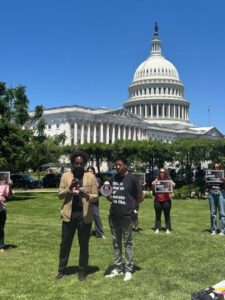 The rally, organized as part of the national Seven Days in June Week of Action, brought our movement together at a critical moment. As Congress considers federal funding decisions that will shape the future of HIV prevention, care, treatment, housing, food assistance, Medicaid, and other essential supports, advocates made one message unmistakably clear:
Survival should not come with a price tag.
“Across the country, our communities are being forced to navigate impossible choices because of policy decisions that threaten Medicaid, housing, food assistance, HIV prevention, treatment access, and the basic supports that make health possible,” said Carl Baloney, Jr., President and CEO of AIDS United. “The Cost of Survival Rally was about naming the truth our communities know too well: health care, housing, food, and dignity should never be treated as luxuries.”
A Movement Made Visible
The photos from the rally tell a story of urgency, solidarity, and resolve.
Across the Capitol grounds, advocates held signs, stood shoulder to shoulder, and lifted up the voices of people who know exactly what is at stake when public health programs are treated as expendable. Speakers from across the HIV movement named the real-world consequences of federal cuts — not in abstract policy terms, but in the language of lived experience.
Throughout the rally, speakers representing national HIV organizations, community-based providers, people living with HIV, public health advocates, and directly impacted communities reminded Congress that the HIV movement is watching, organizing, and demanding action.
Speakers helped ground the event in the human reality behind the policy debate, calling advocates together to make visible the cost of cuts and the urgency of protecting care. Leaders from Seven Days in June, the Save HIV Funding Campaign, AIDS United, and coalition partners reinforced the importance of sustained federal investment in HIV prevention, treatment, housing, and care.
The rally, organized as part of the national Seven Days in June Week of Action, brought our movement together at a critical moment. As Congress considers federal funding decisions that will shape the future of HIV prevention, care, treatment, housing, food assistance, Medicaid, and other essential supports, advocates made one message unmistakably clear:
Survival should not come with a price tag.
“Across the country, our communities are being forced to navigate impossible choices because of policy decisions that threaten Medicaid, housing, food assistance, HIV prevention, treatment access, and the basic supports that make health possible,” said Carl Baloney, Jr., President and CEO of AIDS United. “The Cost of Survival Rally was about naming the truth our communities know too well: health care, housing, food, and dignity should never be treated as luxuries.”
A Movement Made Visible
The photos from the rally tell a story of urgency, solidarity, and resolve.
Across the Capitol grounds, advocates held signs, stood shoulder to shoulder, and lifted up the voices of people who know exactly what is at stake when public health programs are treated as expendable. Speakers from across the HIV movement named the real-world consequences of federal cuts — not in abstract policy terms, but in the language of lived experience.
Throughout the rally, speakers representing national HIV organizations, community-based providers, people living with HIV, public health advocates, and directly impacted communities reminded Congress that the HIV movement is watching, organizing, and demanding action.
Speakers helped ground the event in the human reality behind the policy debate, calling advocates together to make visible the cost of cuts and the urgency of protecting care. Leaders from Seven Days in June, the Save HIV Funding Campaign, AIDS United, and coalition partners reinforced the importance of sustained federal investment in HIV prevention, treatment, housing, and care.
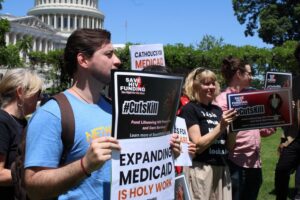 Speakers also lifted up the broader systems that make health possible: Medicaid, housing assistance, food security, harm reduction, transportation, case management, and the community-based organizations that connect people to lifesaving services every day.
Every photo captured a different part of the same truth: our communities are showing up because they have to.
People living with HIV showed up. Providers showed up. Advocates showed up. Public health leaders showed up. Allies showed up. And together, we reminded lawmakers that behind every budget line is a person, a family, a clinic, a case manager, a housing program, a prevention service, a prescription, a meal, a ride to an appointment, and a future that deserves protection.
The Receipt: Showing the True Cost of Cuts
One of the most striking visuals from the rally was the long “receipt” displayed by advocates — a powerful symbol of the costs our communities are being asked to bear.
The receipt did not show luxury items. It showed the basic supports that make survival possible.
Speakers also lifted up the broader systems that make health possible: Medicaid, housing assistance, food security, harm reduction, transportation, case management, and the community-based organizations that connect people to lifesaving services every day.
Every photo captured a different part of the same truth: our communities are showing up because they have to.
People living with HIV showed up. Providers showed up. Advocates showed up. Public health leaders showed up. Allies showed up. And together, we reminded lawmakers that behind every budget line is a person, a family, a clinic, a case manager, a housing program, a prevention service, a prescription, a meal, a ride to an appointment, and a future that deserves protection.
The Receipt: Showing the True Cost of Cuts
One of the most striking visuals from the rally was the long “receipt” displayed by advocates — a powerful symbol of the costs our communities are being asked to bear.
The receipt did not show luxury items. It showed the basic supports that make survival possible.
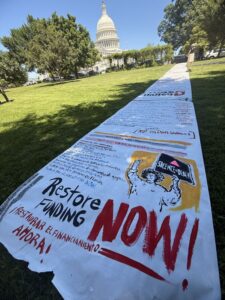 Receipt created by Carlitos Díaz (IG: thealbopapi) of QLatinx (IG: @qlatinx)
VIEW FULL RECEIPT IMAGE
The image was simple, but the message was devastating: when Congress cuts HIV funding and related safety net programs, someone still pays the price.
That price is paid by people who lose access to medication. It is paid by people who fall out of care because transportation disappears. And by people who cannot maintain treatment because housing becomes unstable. Or by clinics forced to stretch already-limited resources.
Community-based organizations are asked to do more with less. Meanwhile, people who are already navigating poverty, stigma, racism, transphobia, criminalization, and barriers to care.
The receipt reminded everyone who saw it that cuts are not savings. They are cost shifts — from the federal government onto the backs of people and communities who can least afford to absorb them.
HIV Funding Is Health Care Funding
At the rally, speakers emphasized that HIV funding is not separate from the broader health care system. It is part of the infrastructure that helps people access preventive care, primary care, mental health services, housing support, medication, and the trusted community-based programs that keep people connected to care.
Federal HIV programs have helped transform what it means to live with HIV in the United States. They have saved lives, reduced new transmissions, strengthened public health systems, and supported generations of people living with and vulnerable to HIV.
But that progress is not guaranteed.
Years of flat funding, rising health care costs, reductions in Medicaid and insurance coverage supports, and increasing strain on state and local systems have left many programs under pressure. In some places, cost-containment measures, service reductions, and growing uncertainty are already threatening access to care.
At a time when we have the tools to prevent new HIV transmissions and support people living with HIV in reaching viral suppression, disinvestment would be both morally indefensible and fiscally short-sighted.
The Human Cost of Policy Decisions
Throughout the rally, speakers returned to a central point: these decisions are not abstract.
A cut to housing support can mean someone loses the stability they need to stay in care.
Cuts to Medicaid can mean someone loses access to the provider they trust.
Reductions in food assistance can mean someone has to choose between groceries and transportation to a medical appointment.
Prevention programs with reduced funding can mean fewer people have access to PrEP, testing, condoms, harm reduction, and culturally competent education.
Community-based organizations losing funding can mean fewer trusted messengers reaching the communities most impacted by HIV.
For people living with and vulnerable to HIV, survival often depends on an ecosystem of support. Medication matters. But so do housing, food, transportation, insurance coverage, case management, mental health care, harm reduction, and trusted community relationships.
When that ecosystem is weakened, people are harmed.
That is why The Cost of Survival Rally mattered. It created space for our movement to connect the dots and make visible what too often gets hidden in appropriations debates and budget charts.
Standing Together at the Capitol
The setting mattered, too.
Receipt created by Carlitos Díaz (IG: thealbopapi) of QLatinx (IG: @qlatinx)
VIEW FULL RECEIPT IMAGE
The image was simple, but the message was devastating: when Congress cuts HIV funding and related safety net programs, someone still pays the price.
That price is paid by people who lose access to medication. It is paid by people who fall out of care because transportation disappears. And by people who cannot maintain treatment because housing becomes unstable. Or by clinics forced to stretch already-limited resources.
Community-based organizations are asked to do more with less. Meanwhile, people who are already navigating poverty, stigma, racism, transphobia, criminalization, and barriers to care.
The receipt reminded everyone who saw it that cuts are not savings. They are cost shifts — from the federal government onto the backs of people and communities who can least afford to absorb them.
HIV Funding Is Health Care Funding
At the rally, speakers emphasized that HIV funding is not separate from the broader health care system. It is part of the infrastructure that helps people access preventive care, primary care, mental health services, housing support, medication, and the trusted community-based programs that keep people connected to care.
Federal HIV programs have helped transform what it means to live with HIV in the United States. They have saved lives, reduced new transmissions, strengthened public health systems, and supported generations of people living with and vulnerable to HIV.
But that progress is not guaranteed.
Years of flat funding, rising health care costs, reductions in Medicaid and insurance coverage supports, and increasing strain on state and local systems have left many programs under pressure. In some places, cost-containment measures, service reductions, and growing uncertainty are already threatening access to care.
At a time when we have the tools to prevent new HIV transmissions and support people living with HIV in reaching viral suppression, disinvestment would be both morally indefensible and fiscally short-sighted.
The Human Cost of Policy Decisions
Throughout the rally, speakers returned to a central point: these decisions are not abstract.
A cut to housing support can mean someone loses the stability they need to stay in care.
Cuts to Medicaid can mean someone loses access to the provider they trust.
Reductions in food assistance can mean someone has to choose between groceries and transportation to a medical appointment.
Prevention programs with reduced funding can mean fewer people have access to PrEP, testing, condoms, harm reduction, and culturally competent education.
Community-based organizations losing funding can mean fewer trusted messengers reaching the communities most impacted by HIV.
For people living with and vulnerable to HIV, survival often depends on an ecosystem of support. Medication matters. But so do housing, food, transportation, insurance coverage, case management, mental health care, harm reduction, and trusted community relationships.
When that ecosystem is weakened, people are harmed.
That is why The Cost of Survival Rally mattered. It created space for our movement to connect the dots and make visible what too often gets hidden in appropriations debates and budget charts.
Standing Together at the Capitol
The setting mattered, too. 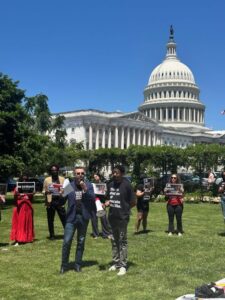 Standing on the Capitol grounds, advocates brought the message directly to the lawmakers whose decisions will determine whether HIV programs are protected, strengthened, or cut. The crowd made clear that people are watching. Communities are organizing. And the HIV movement will not be silent while lifesaving programs are put at risk.
The rally took place ahead of key congressional appropriations decisions, including the House Labor, Health and Human Services, Education, and Related Agencies Appropriations Subcommittee markup and full committee consideration of federal funding levels. Advocates urged Congress to reject cuts and increase investments in HIV prevention, care, treatment, research, and the broader supports that make health possible.
The timing was also deeply significant. That Friday, June 5th, marked 45 years since the first Morbidity and Mortality Weekly Report documented what would later become known as the HIV epidemic. More than four decades later, our movement continues to carry the lessons of that history: silence costs lives, neglect costs lives, and policy choices cost lives.
But we also carry the power of community, care, advocacy, science, and collective action.
Thank You to Everyone Who Showed Up
AIDS United is grateful to every partner, advocate, speaker, staff member, volunteer, and community member who helped make The Cost of Survival Rally possible.
We are especially grateful to Joseph White for helping organize this action and for bringing people together around a message that reflects the urgency of this moment.
We thank our partners in Seven Days in June, the Save HIV Funding Campaign, and the many coalition organizations that continue to fight for the future of HIV prevention, treatment, care, housing, and health equity.
We also thank the speakers who used their voices to make the stakes plain. Their remarks reminded us that this fight is about more than numbers on a page. It is about whether people can afford medication, remain housed, stay insured, access prevention, reach care, and live with dignity.
And we thank every person who showed up — whether you held a sign, shared your story, brought a friend, took a photo, contacted a lawmaker, or simply stood in the crowd to make our movement more visible.
Every person there helped tell a stronger story.
Now Congress must act.
View more photos from The Cost of Survival Rally
Standing on the Capitol grounds, advocates brought the message directly to the lawmakers whose decisions will determine whether HIV programs are protected, strengthened, or cut. The crowd made clear that people are watching. Communities are organizing. And the HIV movement will not be silent while lifesaving programs are put at risk.
The rally took place ahead of key congressional appropriations decisions, including the House Labor, Health and Human Services, Education, and Related Agencies Appropriations Subcommittee markup and full committee consideration of federal funding levels. Advocates urged Congress to reject cuts and increase investments in HIV prevention, care, treatment, research, and the broader supports that make health possible.
The timing was also deeply significant. That Friday, June 5th, marked 45 years since the first Morbidity and Mortality Weekly Report documented what would later become known as the HIV epidemic. More than four decades later, our movement continues to carry the lessons of that history: silence costs lives, neglect costs lives, and policy choices cost lives.
But we also carry the power of community, care, advocacy, science, and collective action.
Thank You to Everyone Who Showed Up
AIDS United is grateful to every partner, advocate, speaker, staff member, volunteer, and community member who helped make The Cost of Survival Rally possible.
We are especially grateful to Joseph White for helping organize this action and for bringing people together around a message that reflects the urgency of this moment.
We thank our partners in Seven Days in June, the Save HIV Funding Campaign, and the many coalition organizations that continue to fight for the future of HIV prevention, treatment, care, housing, and health equity.
We also thank the speakers who used their voices to make the stakes plain. Their remarks reminded us that this fight is about more than numbers on a page. It is about whether people can afford medication, remain housed, stay insured, access prevention, reach care, and live with dignity.
And we thank every person who showed up — whether you held a sign, shared your story, brought a friend, took a photo, contacted a lawmaker, or simply stood in the crowd to make our movement more visible.
Every person there helped tell a stronger story.
Now Congress must act.
View more photos from The Cost of Survival Rally5 Strategies for Integrating Harm Reduction into Clinical Care Harm reduction is more than a clinical approach, it’s a philosophy rooted in respect, dignity, and tangible support. For healthcare providers, having honest conversations about substance use can feel challenging, but applying a harm redu
| Questions to Avoid | Reframed | Why it Works |
| Are you still using ? | How has your use changed or stayed the same since the last time we talked? | The question moves away from a “pass/fail” binary and invites the patient to share their true experience. |
| Why aren’t you taking your medication as prescribed? | What are the biggest hurdles getting in the way of your treatment right now? | This question removes blame and focuses on the underlying factors that present as barriers to the patient’s care. |
| You know that is high-risk, right? | On a scale of 1 to 10, how concerned are you about the impacts of on your health? | This question respects the patient’s autonomy and allows them to define their own level of risk tolerance. |
| Have you given any thought to quitting ? | What are your most important health goals for yourself at this moment? | This question does not assume that cessation is the only valid goal and prioritizes the patient’s immediate needs. |
| Instead of this… | Say this… | Because… |
| Drug addict, druggie, junkie | Person who uses drugs, person who uses substances | It emphasizes the person before the behavior or condition and avoids eliciting negative or punitive associations. |
| Drug abuse | Drug use / misuse | The term “abuse” is found to have high association with negative beliefs and punishment. |
| Clean/dirty | Abstinent or not currently using drugs / living in remission or recovery / Testing reactive or non-reactive for drugs | Using terms like “clean” or “dirty” can elicit connotations of moral purity or impurity. People are not actually “dirty” or “clean,” if they do or or don’t use drugs. |
| Relapse | Recurrence / Return to use | The term "relapse" can evoke feelings of shame or imply failure. Using terms like “recurrence” or “return to use” frames substance use through the lens of the disease model of addiction and acknowledges setbacks are common and do not diminish progress. |
Public health leaders from AIDS United, Emory University’s Rollins School of Public Health, the Black Public Health Academy, and the National Pharmaceutical Association announced this week a new initiative to help community pharmacies expand HIV prevention services in communities disproportionately
AIDS United Fiscal Year 2027 Testimony prepared for the House Committee on Appropriations Subcommittee on Labor, Health and Human Services, Education, and Related Agencies Dear Chairman Cole and Ranking Member DeLauro: As the subcommittee advances its work on the Fiscal Year (FY) 2027 Labor, Health
Each year on April 10, National Youth HIV/AIDS Awareness Day (NYHAAD) serves as a vital reminder that the fight to end the HIV epidemic must center on the next generation. Currently, young people aged 13–24 account for approximately 20% of all new HIV diagnoses in the United States (CDC, 2023). With
AIDS United Statement on the Release of President Trump’s FY27 Budget WASHINGTON — On April 3, the Trump Administration released its Fiscal Year 2027 discretionary budget request. It makes clear, once again, that the health and well-being of Americans is not a governing priority. Instead, this propo
AIDSWatch 2026 Galvanizes Hundreds of Advocates on Capitol Hill to Demand Action on HIV Epidemic WASHINGTON, D.C. – March 30. 2026 AIDS United successfully concluded AIDSWatch 2026, the nation's largest annual HIV advocacy event, bringing nearly 600 advocates from 42 states and territories to Washin
“Defending Progress, Demanding Justice” — the theme that guided advocates as they confronted lawmakers on the most pressing issues facing the HIV community.
Policy Priorities Discussed
AIDSWatch 2026 participants directly discussed pressing policy priorities with Members of Congress and their staffs, including ensuring access to treatment and a high quality of life for all people living with HIV; mitigating the impact of federal funding cuts and attacks on vulnerable communities; supporting HIV prevention efforts and increased PrEP access across the country; and maintaining robust U.S. support for the global HIV response.
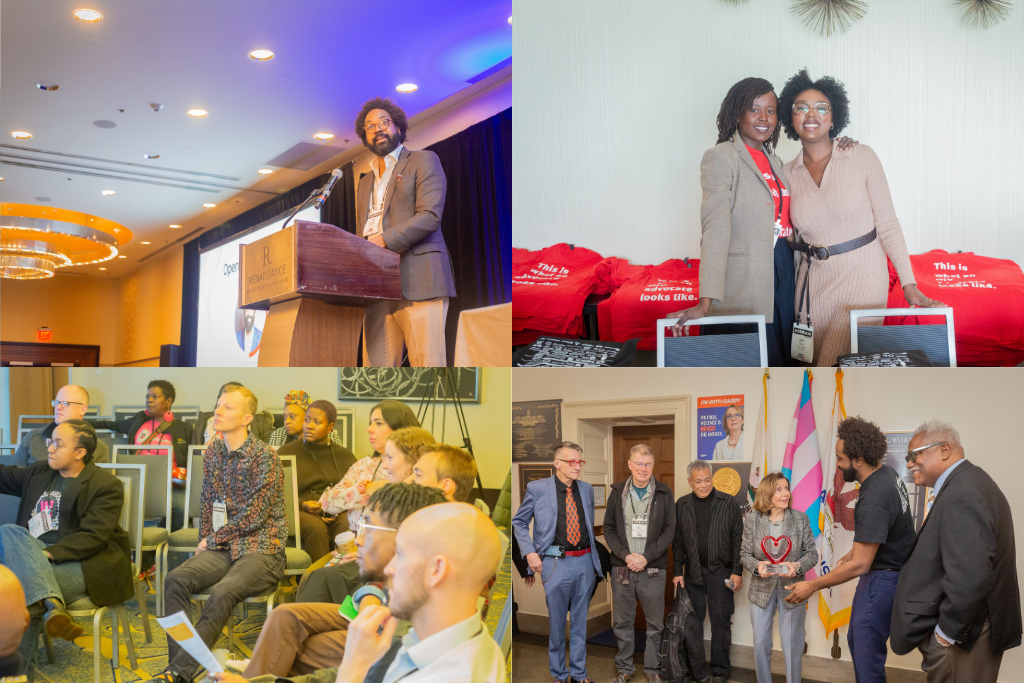
“AIDSWatch 2026 was a powerful demonstration of collective advocacy at a pivotal moment for the HIV movement. Our advocates came to Washington not just to observe, but to demand that their voices be heard. They made it unequivocally clear that progress in the fight against HIV does not happen by accident; it requires sustained political will and unwavering commitment to justice.”
— Carl Baloney, Jr., President & CEO, AIDS United
Event Highlights
Media Interview Opportunities
AIDS United leadership and experts are available for interviews to discuss:
About AIDS United
AIDS United's mission is to end the AIDS epidemic in the United States through strategic grantmaking, capacity building, and policy advocacy. Learn more at aidsunited.org
About AIDSWatch
AIDSWatch is the largest national HIV advocacy event, bringing together hundreds of people living with HIV and their allies to educate members of Congress about the importance of federal funding and sound policies to address the HIV epidemic. AIDSWatch is presented by AIDS United in coordination with the U.S. People Living with HIV Caucus and the Center for Health Law and Policy Innovation at Harvard Law School.
Media Contact
Miguel Ayala Director of Communications mayala@aidsunited.org 202-876-2820
AIDSWatch 2026 to Honor Congressional Champions and Bring Hundreds of HIV Advocates to Washington to Defend Progress, Demand Justice Conference and Congressional Reception to spotlight HIV policy leaders, urgent threats to care and prevention, and the voices of people living with HIV WASHINGTON — AI
AIDSWatch 2026 to Honor Congressional Champions and Bring Hundreds of HIV Advocates to Washington to Defend Progress, Demand Justice
Conference and Congressional Reception to spotlight HIV policy leaders, urgent threats to care and prevention, and the voices of people living with HIV
WASHINGTON — AIDS United today announced the honorees for AIDSWatch 2026 and invited journalists to attend and cover the nation’s largest constituent-driven federal HIV advocacy event, taking place March 16–18, 2026, at the Renaissance Arlington Capital View Hotel and on Capitol Hill. This year’s AIDSWatch theme, “Defending Progress, Demanding Justice,” reflects the urgency of this moment as HIV advocates confront mounting political, budgetary, and structural threats to prevention, treatment, care, housing, research, and civil rights.
At a time when hard-won progress is under renewed attack, AIDSWatch 2026 will bring together advocates, people living with HIV, policy experts, and allies from across the country to push Congress to protect lifesaving programs and advance an HIV response rooted in dignity, equity, and justice. AIDSWatch is the largest constituent-driven HIV federal advocacy event in the country, representing a community of 1.2 million people living with HIV in the United States.
This year, AIDS United will recognize Representative Bonnie Watson Coleman for her steadfast partnership and leadership in the fight for HIV justice, and Representative Robert Garcia for his advocacy on behalf of communities living with and vulnerable to HIV — and for the promise of his continued leadership in Congress in the years ahead. The event will also celebrate the career-long dedication to HIV and AIDS advocacy by Speaker Emerita Nancy Pelosi. She will be presented with a Lifetime Achievement award honoring her groundbreaking role in bringing the AIDS crisis into the halls of Congress from day one of her Congressional career and helping force national leaders to confront a public health emergency that far too many once ignored.
“Speaker Emerita Pelosi helped change what was politically possible in the fight against HIV and AIDS,” AIDS United CEO and President, Carl Baloney, Jr., said. “She used her power to insist that the lives of people living with HIV mattered, that the federal government had a responsibility to act, and that silence was never an option. In honoring leaders at AIDSWatch 2026, we celebrate not only what they have done, but what this moment demands from Congress now and in the years ahead.”
The stakes could not be higher. In the United States, approximately 1.2 million people are living with HIV, and about 1 in 8 do not know their status. In 2023, more than 39,000 people were diagnosed with HIV in the U.S. and affiliated jurisdictions, with the South continuing to shoulder the heaviest burden. Yet the infrastructure that communities rely on is under intense pressure. KFF has reported that CDC represents 91% of all federal HIV prevention funding, even as the FY2026 White House budget request proposed eliminating CDC’s HIV prevention funding line and the Trump Administration is seeking to cut $600 million in key HIV prevention and public health funding in California, Colorado, Illinois, and Minnesota.
At the same time, people living with HIV are facing a convergence of threats: attacks on Medicaid and affordable coverage, instability in prevention infrastructure, stigma and discrimination that still deter care, and state-level decisions that can abruptly cut people off from medication and support. Federal officials recently postponed the March 2026 meeting of the U.S. Preventive Services Task Force for the third consecutive time, prompting concern about the future of access to no-cost preventive services such as PrEP. In Florida, an emergency state rule that went into effect March 1st is expected to push roughly 16,000 people off AIDS Drug Assistance Program support, a stark reminder that access to treatment remains fragile for far too many Americans.
AIDSWatch 2026 will give journalists multiple opportunities to cover both the policy substance and the human stories driving the HIV movement. Program highlights include:
Among the sessions expected to resonate most in this political moment are conversations on immigrant communities’ access to HIV care under intensified enforcement, the defense of Black-led HIV research and prevention strategies, the criminalization and coercion that still shape parts of the HIV response, and the role of narrative advocacy in moving policymakers to action.
“Journalists covering health care, Congress, LGBTQ+ communities, racial justice, budget fights, and the future of the social safety net will find an essential story at AIDSWatch,” AIDS United CEO and President, Carl Baloney, Jr., added. “This is where policy meets real life. The people most affected by HIV are coming to Washington to tell Congress exactly what is at stake.”
Media are invited to attend and cover select portions of AIDSWatch 2026, including the plenary, the Congressional Reception, the Capitol Hill rally, and interviews with advocates, policy leaders, and AIDS United representatives.
AIDSWatch 2026 WHEN: March 16–18, 2026 MAIN VENUE: Renaissance Arlington Capital View Hotel, 2800 Potomac Ave, Arlington, VA 22202 Congressional Reception: Tuesday, March 17, 6:00–8:00 p.m., Rayburn House Office Building, Rayburn Cafeteria Rally: Wednesday, March 18, 8AM - Capitol Lawn/House side
Members of the Media may RSVP Here - https://forms.gle/YgjExMj5eGtZ4Biv5
Resources: AIDSWatch 2026 agenda:https://aidsunited.org/action/aidswatch/ AIDSWatch FAQ: https://aidsunited.org/action/aidswatch/faq/
Press Contact: Miguel A. Ayala communications@aidsunited.org 202-876-2820
About AIDSWatch AIDSWatch is presented by AIDS United and partner organizations as the nation’s largest constituent-driven federal HIV advocacy event, bringing together people living with HIV, community leaders, and allies to educate lawmakers and advocate for policies and funding to end the HIV epidemic.
On National Black HIV/AIDS Awareness Day, we honor the lives, leadership, and legacy of Black people who have shaped the HIV response in this country, often in the face of […]
On National Black HIV/AIDS Awareness Day, we honor the lives, leadership, and legacy of Black people who have shaped the HIV response in this country, often in the face of profound neglect, hostility, and loss.
This moment demands honesty. We are living through a political climate marked by coordinated attacks on public health, civil rights, bodily autonomy, and the institutions meant to protect us. Harm reduction is under siege. HIV prevention and care are being politicized. Black communities, particularly Black women, Black LGBTQ people, and Black trans people, continue to bear the brunt of these assaults.
And still, we are here.
The truth is this: the progress we have made against HIV exists because Black people organized when institutions failed. Black advocates demanded action when silence meant death. Black researchers, clinicians, and community leaders built systems of care where none existed. Black organizers redefined what justice, dignity, and survival look like in practice. Every major advance in HIV, from treatment access to prevention breakthroughs, carries the imprint of Black leadership.
We should name what that progress represents. HIV is no longer a death sentence. Millions are living long, full lives. New prevention tools exist that were once unimaginable. Entire generations have been spared because people refused to accept indifference as policy.
But progress is not the same as power, and it is not the same as justice.
HIV remains a proxy for deeper inequities in this country. Where HIV thrives, so do poverty, housing instability, criminalization, gender-based violence, restricted access to care, and political disinvestment. The same systems that drive HIV disparities are the systems that weaken democracy, erode worker protections, restrict voting rights, and determine whose lives are deemed worthy of investment.
Ending the HIV epidemic requires more than services. It requires organized communities with the power to shape policy, hold institutions accountable, and demand a government that works for us.
Today is not just about awareness. It is about building power.
I am calling on policymakers to protect and expand HIV funding, not retreat from it. I am calling on funders to invest boldly in Black-led organizations and long-term movement infrastructure, not just short-term outcomes. I am calling on advocates to organize across issues, mobilize voters, and connect HIV to the broader fight for racial justice, health equity, and human rights. And I am calling on all of us to refuse a future where Black lives are treated as expendable in public health policy.
Black people have always led this fight, not only to survive, but to transform the systems that failed us.
On this National Black HIV/AIDS Awareness Day, let us honor the past, defend the present, and organize relentlessly for a future where ending the HIV epidemic is inseparable from building a more just, equitable, and democratic society.
— Carl Baloney, Jr.
If you want to invest in Black leadership and Black power in the HIV movement, I invite you to support the Cornelius Baker Fellowship Fund. Your contribution helps build the organizing, policy, and movement infrastructure we need not just to end the HIV epidemic, but to transform the systems that sustain it.
On National Black HIV/AIDS Awareness Day, we honor the lives, leadership, and legacy of Black people who have shaped the HIV response in this country, often in the face of profound neglect, hostility, and loss. This moment demands honesty. We are living through a political climate marked by coordina
Funders Concerned About AIDS (FCAA) is alarmed by today’s announced termination of critical federal grants administered by the Substance Abuse and Mental Health Services Administration (SAMHSA). These abrupt cuts — which reports indicate total nearly $2 billion in addiction, mental health, and commu
“Behavioral health, harm reduction, and social support are not ancillary to the HIV response — they are essential. When these services disappear, people living with HIV face greater barriers to staying engaged in care, managing co-occurring mental health and substance-use conditions, and maintaining stability in the face of already fragile safety nets.”— Masen Davis, Executive Director, Funders Concerned About AIDS
FCAA’s forthcoming resource tracking report shows that, even prior to today’s announcement, total U.S. HIV-related philanthropy in 2024 was approximately $316 million. While this level of philanthropic investment reflects deep commitment, it pales in comparison to the scale of public funding now being withdrawn. Philanthropy alone cannot absorb or replace the sudden loss of billions in federal support. Without intervention, closures and severe capacity reductions among key organizations serving impacted populations are inevitable.
“Terminating SAMHSA grants overnight is a direct hit to the services that keep people alive and connected to care. Programs like harm reduction, crisis response, treatment, and mental health support will take the direct hit. When those supports disappear, HIV outcomes worsen. People fall out of care, risk rises, and preventable deaths follow. This is an urgent public health emergency, and these grants must be restored.”— Carl Baloney Jr., President and CEO, AIDS United and Board Member, Funders Concerned About AIDS The scale and speed of today’s SAMHSA grant terminations make one reality clear: the HIV response cannot succeed without sustained public investment, and philanthropy cannot be expected to shoulder this burden alone. FCAA stands ready to support funders, service providers, and advocates in responding to this crisis. We urge philanthropic partners to prioritize flexible, general operating support; coordinate rapidly with peers to address acute gaps; strengthen advocacy to protect and restore public funding; and engage FCAA as a resource for timely data, donor coordination, and shared strategy. --- View the original post here.For Immediate Release - AIDS United Announces AIDSWatch@Home 2025-2026 Grant Recipients Contact - Miguel A. Ayala, Director of Communications, communications@aidsunited.org Washington, D.C., January 13, 2026 – AIDS United has selected eight organizations to receive grants of up to $15,000 each for t
As we near the end of 2025, and as public health becomes increasingly politicized, attacks on sexual and reproductive health are more apparent than ever. Whether it be through Supreme Court cases, political opposition, or funding cuts, the same forces driving policies that negatively impact people l
AIDS United welcomes Miguel A. Ayala (he/him/his) as director of communications. Contact: communications@aidsunited.org Washington, D.C., December 19, 2026 -- Miguel A. Ayala is a strategic communications leader driven by a lifelong commitment to breaking down barriers, expanding opportunity, and co
Nationally, HIV incidence among African immigrants is six times higher than in the general population and nearly twice that of US-born Black individuals.1,2 According to research published by researchers Brisola Ojikutu and Chioma Nnaji, African immigrants are less likely to test for HIV and often p
We are at a pivotal moment for the HIV movement and for public health in America. For decades, political leaders disagreed on many things, but there was a broad understanding that protecting the nation’s health was a shared responsibility. Administrations were judged, in part, on how well they navig
Each year on December 1, we recognize World AIDS Day — a moment for our community to honor the lives lost to the HIV/AIDS epidemic and recommit ourselves to ending the epidemic once and for all. This year, against the backdrop of the federal government's silence, loudly recognizing World AIDS Day is
Transgender Day of Remembrance and Resilience (TDOR) is an annual observance on November 20 that honors the memory of the transgender, nonbinary, and gender-nonconforming (TGNC) people whose lives were lost in acts of anti-transgender violence. On Transgender Day of Remembrance, AIDS United remember
The story of HIV in America is, at its core, the story of inequities. It has always been more than a virus. It is about who has access to healthcare, who is silenced by stigma, and who is left out of the rooms where decisions are made. And even in our own sector, which champions equity, leadership s
All individuals, regardless of their age, have the right to make informed, autonomous decisions about their reproductive health; for people aging with HIV, these decisions can be more complex. Now, as HIV drugs are allowing many to lead longer, healthier lives, discussions about getting and being ol
The "Voices of Community" blog is more than a platform, it is a promise. A promise that our stories, in all their complexity and truth, will shape the narrative of HIV advocacy. By telling our own stories, we ensure that the future of this movement is not written for us, but by us. Carrying Our Stor
The "Voices of Community" blog is more than a platform, it is a promise. A promise that our stories, in all their complexity and truth, will shape the narrative of HIV advocacy. By telling our own stories, we ensure that the future of this movement is not written for us, but by us.
Carrying Our Stories, Building Our Futures, by Mallery Jenna Robinson I often say that my life's work has been shaped at the intersection of identity, survival, and community. As a Black transgender woman with Afro-Caribbean roots, I know firsthand what it means to navigate a world where HIV stigma, transphobia, and systemic racism collide. These experiences have not only influenced my journey; they have become the very reason I step into spaces of advocacy, leadership, and storytelling. My entry into HIV/AIDS work came through community. Growing up, I heard stories of friends, elders, and chosen family who were lost to the epidemic, and others who were surviving against the odds. Their resilience left an imprint on me. By the time I began serving on advisory boards and engaging in outreach programs, I understood that this work was about more than medical care, it was about dignity, justice, and the possibility of joy. Over the past thirteen years, I've had the privilege of serving on multiple boards, including the West Hollywood Transgender Advisory Board, the Long Beach Transwellness Board, and Being Alive HIV Board, among others. Each role has taught me something different, but together they have reinforced a central truth: our communities carry deep wisdom, and that wisdom must guide the future of HIV care and advocacy. Too often, policies and programs are built without the voices of those most impacted. We cannot afford that silence any longer. My Afro-Caribbean heritage has also shaped how I view this work. From my Haitian ancestors, I inherited not only resilience but also a tradition of resistance and community care. These values guide how I show up in the HIV sector. When I advocate for leadership opportunities for Black, Latinx, and trans communities, I am carrying forward that ancestral call to liberation. For me, equity is not just a policy demand; it is a spiritual obligation. The future of HIV care must extend beyond the clinic. Yes, access to treatment and prevention is critical. But care also means addressing housing insecurity, mental health needs, and systemic discrimination. It means creating spaces where people living with HIV can thrive, not just survive. I envision a future where care is holistic, where providers, advocates, and policymakers listen to community voices and respond with compassion and resources, not judgment or red tape. Storytelling has been one of the most powerful tools in my work. Through projects like A Hateful Homicide and my transgender empathy trainings, I've seen how sharing lived experiences can open hearts and shift perspectives. Statistics may capture the scale of the epidemic, but stories capture its humanity. When we tell our truths about survival, about stigma, and about joy, we move people from awareness to action. This is why amplifying community voices, through platforms like this blog, is so vital. In recent conversations within the community, I've noticed a recurring theme: the need to reclaim joy. For too long, HIV has been framed solely in terms of tragedy, loss, or crisis. While it is true that we have endured immense grief, it is equally true that we have created resilience, love, and creativity that defy the odds. Joy is not a luxury, it is a form of resistance. By celebrating survival, by dancing, by loving openly, we affirm our humanity in a world that has often tried to erase us. Looking forward, my hope is that the sector continues to evolve with equity, sustainability, and community leadership at its core. This means shifting from short-term projects to long-term investments in grassroots organizations. It means creating leadership pipelines that uplift young people, especially queer and trans youth of color. And it means holding ourselves accountable, not only to funders or institutions, but to the communities whose lives are on the line. As a community leader, I carry both memory and vision. I carry the memory of those we lost to the epidemic, the mentors who taught me how to fight, and the peers who remind me every day why this work matters. And I carry the vision of a future where people living with HIV are not just surviving, but thriving; where equity is a lived reality, not just a buzzword; and where joy is recognized as central to our collective liberation. About the Author: Mallery Jenna Robinson is an AfraCarribean Binary Transgender woman and HIV advocate for Los Angeles and the State of California. The "Voices of Community" blog is more than a platform, it is a promise. A promise that our stories, in all their complexity and truth, will shape the narrative of HIV advocacy. By telling our own stories, we ensure that the future of this movement is not written for us, but by us. The Voices of Community blog features reflections from across the HIV/AIDS sector. We welcome submissions rooted in lived experience, fresh ideas, and new perspectives. Contact ted@the-collective-good.com to contribute.On October 1, 2025, the federal government shut down after Congress failed to reach agreement on a continuing resolution to fund the government and protect affordable healthcare. This shutdown was entirely avoidable. It stems from the refusal of Congressional Republicans to work with their Democrati
Over the past 40 years, the United States has led the charge in achieving groundbreaking medical and scientific advancements that have resulted in the creation of lifesaving HIV treatments and HIV prevention tools like pre-exposure prophylaxis (PrEP). These advances have turned a disease that was on
AIDS United’s Melanated Movement team is proud to announce the launch of the Melanated Movement Engagement Advisory Council, a group of women-identified leaders committed to reshaping the narrative around HIV care and prevention for both Cisgender and Transgender women. Rooted in the principles of V
AIDS United’s Melanated Movement team is proud to announce the launch of the Melanated Movement Engagement Advisory Council, a group of women-identified leaders committed to reshaping the narrative around HIV care and prevention for both Cisgender and Transgender women.
Rooted in the principles of ViiV Healthcare’s From Risk to Reasons initiative, the Melanated Movement portfolio focuses on the motivations, strengths, and resilience that empower Black women to take charge of their sexual and reproductive health for both Cisgender and Transgender women. The Advisory Council will serve as a guiding body, helping shape the program’s growth, outreach, and impact while ensuring that the voices and experiences of Black women remain at the center of the work.
The Advisory Council will provide recommendations on programmatic plans, awareness day activities, and opportunities for new engagement. Members will also advise on technical assistance priorities and ensure the initiative reflects the diversity of experiences among Black women and girls most impacted by HIV.
The Advisory Council will serve a two year term to help advance the goals to design and execute a comprehensive sexual, reproductive health, and HIV awareness campaign by and for Black women, integrating prevention, treatment, policy, funding, and research platforms; and strengthen connections between women in the movement and their allies, building collaboration opportunities with fellow grantees and national partners.
Bridgette Picou, LVN, ACLPN
Bridgette is a licensed vocational and certified AIDS Care Nurse based in Palm Springs, California. She works for The Well Project as stakeholder liaison, representing women living with and affected by HIV across medical, research, policy, and advocacy spaces. She serves as director at large for the Association of Nurses in AIDS Care (ANAC) and sits on the board of the HIV & Aging Research Project–Palm Springs (HARP-PS). Living at the intersections of being Black, a woman, and thriving with HIV, Bridgette works to ensure the humanity behind HIV is always seen and uplifted.
Shambria Davis, MPH, MS, LSSYB
Shambria is a public health strategist, capacity-building specialist, and communications advocate dedicated to amplifying the voices of Black women and women of color. With more than a decade of experience in HIV outreach, health equity communications, and organizational development, she has worked across grassroots and national platforms to drive culturally relevant engagement. Her journey with the Melanated Movement began as a supporter and contributor to its mission. Now, as an Advisory Council member, Shambria brings her full voice and strategic lens to help reimagine advocacy, communications, and care for Black and Brown women.
Ronnie L. Taylor
Ronnie serves as the Community Impact Director at FreeState Justice and is the Acting Commissioner on the Maryland Commission on Hate Crime Response and Prevention. A longtime advocate, she became the first openly transgender Chief of Staff in the Maryland General Assembly. At FreeState Justice, she leads community advocacy, policy, development, and engagement efforts. Ronnie has been featured on WBAL TV, NBC 4 Washington, WUSA 9, and The Washington Blade, and emceed the first Transgender Day of Visibility at the Maryland State House in 2023. A Prince George’s County native, she also teaches African American Studies as an adjunct professor.
Masonia B. Traylor
Masonia is a mother, global HIV activist, and certified speaker dedicated to supporting women and youth impacted by HIV/AIDS. She is the Executive Director of Lady BurgAndy Inc., a nonprofit focused on education, prevention, and advocacy in the Southeastern U.S. A recognized leader in trauma-informed care and perinatal transmission, she has been featured in campaigns and magazines nationwide. Masonia serves as a community ambassador and advisory board member for several organizations, and is a proud Community Captain for ViiV’s Risk to Reasons Initiative.
Zahara Bassett
Zahara Bassett is the President and Chief Executive Officer of Life is Work, a Chicago-based nonprofit she founded in 2017 to provide vital resources, housing advocacy, and affirming care for LGBTQ+ communities of color. A Black woman of trans experience and native of Chicago’s Austin community, Zahara turned her lived experiences with systemic inequities into fuel for building solidarity and support across the LGBTQ+ movement.
She previously served as Director of Development at Brave Space Alliance, where she led a crisis food pantry campaign that raised over $1 million, and has collaborated with the AIDS Foundation of Chicago, the Human Rights Campaign, and Illinois’ Learning Circle Collaborative. In 2021, she was appointed to Illinois Governor J.B. Pritzker’s Health and Human Service Task Force.
Zahara’s leadership has been recognized with numerous honors, including the Chicago Foundation for Women’s Impact Award (2022), induction into the Chicago LGBTQ Hall of Fame (2022), and the ESTEEM Award for Outstanding Service, Transgender (2022). She continues to champion trans visibility and equity, notably through hosting Chicago’s annual Trans Visibility Pageant, which uplifts and celebrates trans community leaders. About Melanated Movement: The Melanated Movement Fund empowers Black women by expanding access to tailored HIV prevention and care through strategic funding, capacity building, and technical assistance. This initiative supports community-based organizations in delivering comprehensive services that address the unique needs of Black cis and trans women, fostering advocacy, education, and holistic well-being. Our movement is committed to empowering Black women through education, open dialogue, and strategic investments, ensuring that their voices and experiences are uplifted and valued. The MM Fund funds Five (5) community-based organizations-Multi-Cultural AIDS Coalition, The Outlaw Project, The Women’s Collective, Dandelions and AIDS Outreach Center receive multi-year funding and support to implement activities.
The Melanated Movement Engagement initiative, centers stigma reduction, storytelling, and prevention and care for Black women of all experiences impacted by HIV. Our national messaging campaign is committed to empowering Black women through education, open dialogue, and strategic investments, ensuring that their voices and experiences are valued. To learn more about the Melanated Movement and its work to advance HIV care and prevention for Black women, visit https://aidsunited.org/action/melanated-movement/August 29 marks National Faith HIV/AIDS Awareness Day, a day to engage faith communities to raise awareness about HIV prevention, care, treatment and stigma. For this year’s NFHAAD, we spoke with Bishar Jenkins Jr., current AIDS United Board Member and recent graduate from Yale Divinity School, abou
The interview is supported in part by We Are United, a program initiative of The Conexiones Positivas Fund in partnership with the CDC's Let's Stop HIV Together and Together Take Me Home campaigns. Click here to order your free at-home HIV self-testing kit or explore sexual health resources.
AIDS United is excited to announce that we will be joining advocates, organizers, and community leaders at this year’s U.S. Conference on HIV/AIDS (USCHA) in Washington D.C.! We are honored to contribute to the program with a variety of sessions, workshops, and opportunities to connect. Our staff wi
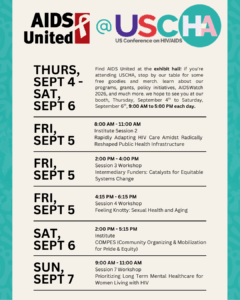
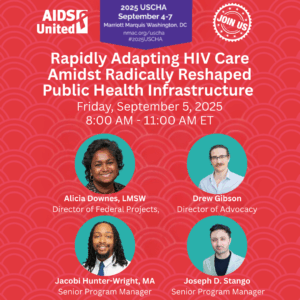 8:00 AM - 11:00 AM: Institute Session 2, Rapidly Adapting HIV Care Amidst Radically Reshaped Public Health Infrastructure
Presenters: Alicia Downes, LMSW, Director of Federal Projects; Drew Gibson, Director of Advocacy; Jacobi Hunter-Wright, MA, Senior Program Manager; Joseph D. Stango, Senior Program Manager
2:00 PM - 4:00 PM: Session 3 Workshop, Intermediary Funders: Catalysts for Equitable Systems Change
Presenters: Dr. Athena Cross, Vice President and Chief Programs Officer
8:00 AM - 11:00 AM: Institute Session 2, Rapidly Adapting HIV Care Amidst Radically Reshaped Public Health Infrastructure
Presenters: Alicia Downes, LMSW, Director of Federal Projects; Drew Gibson, Director of Advocacy; Jacobi Hunter-Wright, MA, Senior Program Manager; Joseph D. Stango, Senior Program Manager
2:00 PM - 4:00 PM: Session 3 Workshop, Intermediary Funders: Catalysts for Equitable Systems Change
Presenters: Dr. Athena Cross, Vice President and Chief Programs Officer
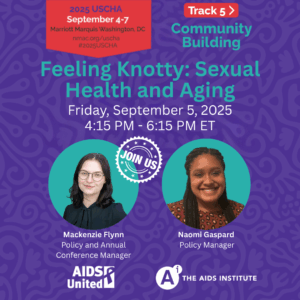 4:15 PM - 6:15 PM: Session 4 Workshop, Feeling Knotty: Sexual Health and Aging
Presenters: Mackenzie Flynn, Policy and Annual Conference Manager; Naomi Gaspard, Policy Manager at The AIDS Institute
4:15 PM - 6:15 PM: Session 4 Workshop, Feeling Knotty: Sexual Health and Aging
Presenters: Mackenzie Flynn, Policy and Annual Conference Manager; Naomi Gaspard, Policy Manager at The AIDS Institute
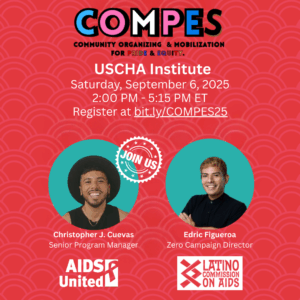 2:00 PM - 5:15 PM: Institute, COMPES (Community Organizing & Mobilization for Pride & Equity). Registration required: bit.ly/COMPES25
Presenters: Christopher J. Cuevas, Senior Program Manager; Edric Figueroa, Zero Campaign Director at the Latino Commission on AIDS
2:00 PM - 5:15 PM: Institute, COMPES (Community Organizing & Mobilization for Pride & Equity). Registration required: bit.ly/COMPES25
Presenters: Christopher J. Cuevas, Senior Program Manager; Edric Figueroa, Zero Campaign Director at the Latino Commission on AIDS
 9:00 AM - 11:00 AM: Session 7 Workshop, Prioritizing Long Term Mental Healthcare for Women Living with HIV
Presenters: Laura Gerson, CHES, Capacity Building Specialist
9:00 AM - 11:00 AM: Session 7 Workshop, Prioritizing Long Term Mental Healthcare for Women Living with HIV
Presenters: Laura Gerson, CHES, Capacity Building Specialist
“Leadership and learning are indispensable to each other.” John F. Kennedy said that both are equally necessary for success. To who this may concern, I have dedicated my life to uplifting and empowering others who have been affected and infected with HIV. I always want to look at people as people fi
 “Leadership and learning are indispensable to each other.”
John F. Kennedy said that both are equally necessary for success.
“Leadership and learning are indispensable to each other.”
John F. Kennedy said that both are equally necessary for success.
About the Southern HIV Impact Fund: The Southern HIV Impact Fund is a pooled fund with a coordinated approach to bring a strategic focus on HIV care and prevention services, advocacy and movement-building, and leadership development efforts in the South. The fund provides tailored technical assistance, leadership development, and one-year grants to HIV service, social justice, and civil rights organizations in the South.
Through (SHIF) Leadership Development Cohort program, we aim to build the capacity of emerging leaders in the HIV movement by providing hands-on leadership training, and financial support to support project that address needs of individuals and communities affected by HIV in the South. To whom it may concern is a series of impact stories and testimonies from grantees and members of the SHIF’s Leadership Development Program, cohort #8.Click here to support AIDS United work in the Southern region.
The Partnership to End HIV, STDs, and Hepatitis is deeply concerned about recent reports that the Trump Administration is planning to unlawfully prevent the disbursement of already Congressionally appropriated Fiscal Year 2025 funding to Ryan White HIV/AIDS Program Part F grantees. Such an action wo
 The Partnership to End HIV, STDs, and Hepatitis is deeply concerned about recent reports that the Trump Administration is planning to unlawfully prevent the disbursement of already Congressionally appropriated Fiscal Year 2025 funding to Ryan White HIV/AIDS Program Part F grantees. Such an action would have devastating consequences to our nation’s ability to provide effective, innovative, and holistic health care to people living with HIV in the United States. It would send an unmistakable message to the HIV community and to the nation that the current Administration is not committed to ending the domestic HIV epidemic.
Part F of the Ryan White HIV/AIDS Program encompasses the AIDS Education and Training Centers (AETCs), Special Projects of National Significance (SPNS), and the Ryan White Dental Program. These programs are essential to creating the comprehensive system of care that has resulted in an astonishing 90.6% success rate for the Ryan White Program in achieving viral suppression for its clients compared to a nationwide average of 65%.
The AETCs are the national leaders in building the capacity of HIV clinics and care teams to provide the kind of culturally informed and evidence-based biomedical prevention, testing, and treatment services for HIV and related comorbidities. Not only do they increase the size and strengthen the skills of the current HIV clinical workforce, but they also develop the next generation of practitioners by working with health professions schools to integrate HIV and interprofessional education into their curricula.
At the same time, the SPNS program serves as a vital laboratory for innovation in combating our national HIV epidemic, providing opportunities for the development of more impactful and more cost-efficient interventions to better respond to the emerging needs of people living with HIV, which drive the sector forward. The Ryan White Dental Program is crucial to provide access to oral health care for people with HIV, which is necessary to prevent avoidable infections and support overall health.
The proposed withholding of already Congressionally appropriated Ryan White Program Part F funding imperils the success of the federal government’s Ending the HIV Epidemic initiative, which was launched in 2019 by the first Trump administration. “Part F programs are essential to health departments’ ability to deliver comprehensive, high-quality HIV care,” said Stephen Lee, MD, Executive Director of the National Alliance of State and Territorial AIDS Directors. “They provide training, innovation, and specialized services that strengthen the entire Ryan White Program and ensure people living with HIV receive the care they need.”
“Failure to disburse FY25 funding to Ryan White Part F programs in its entirety would have lasting and devastating consequences for people living with and affected by HIV in the United States,” said Carl Baloney Jr., Chief Executive Officer at AIDS United. “At a time when much of the HIV workforce is approaching retirement and our systems are already understaffed and underresourced, it is imperative that we provide these essential programs with the funding they need to develop the next generation of HIV providers.”
“The Ryan White Program is the backbone of our nation's HIV safety net," said Michael Ruppal, Executive Director at The AIDS Institute. "It is a successful and effective program that should serve as a model for the health care system. Part F is an essential component of that success. Unilaterally withholding funding runs contrary to the Administration's stated goal of improving government efficiency and ending the HIV epidemic.”
“Part F of the Ryan White Program is where innovation meets equity — it trains the providers, builds the clinics, and ensures culturally competent care reaches the people who need it most,” said Paul Kawata, Executive Director of NMAC. “Delaying or denying this funding is not just a bureaucratic misstep — it’s a direct threat to our progress in ending the HIV epidemic, particularly in communities of color that have long been underserved.”
The Partnership calls on the Trump Administration to release all Congressionally appropriated FY25 Ryan White Program Part F funds immediately, and to recommit to their investment in ending the HIV epidemic in the United States.
For more information on the Partnership’s work, visit http://endhivstdhep.org.
The Partnership to End HIV, STDs, and Hepatitis is deeply concerned about recent reports that the Trump Administration is planning to unlawfully prevent the disbursement of already Congressionally appropriated Fiscal Year 2025 funding to Ryan White HIV/AIDS Program Part F grantees. Such an action would have devastating consequences to our nation’s ability to provide effective, innovative, and holistic health care to people living with HIV in the United States. It would send an unmistakable message to the HIV community and to the nation that the current Administration is not committed to ending the domestic HIV epidemic.
Part F of the Ryan White HIV/AIDS Program encompasses the AIDS Education and Training Centers (AETCs), Special Projects of National Significance (SPNS), and the Ryan White Dental Program. These programs are essential to creating the comprehensive system of care that has resulted in an astonishing 90.6% success rate for the Ryan White Program in achieving viral suppression for its clients compared to a nationwide average of 65%.
The AETCs are the national leaders in building the capacity of HIV clinics and care teams to provide the kind of culturally informed and evidence-based biomedical prevention, testing, and treatment services for HIV and related comorbidities. Not only do they increase the size and strengthen the skills of the current HIV clinical workforce, but they also develop the next generation of practitioners by working with health professions schools to integrate HIV and interprofessional education into their curricula.
At the same time, the SPNS program serves as a vital laboratory for innovation in combating our national HIV epidemic, providing opportunities for the development of more impactful and more cost-efficient interventions to better respond to the emerging needs of people living with HIV, which drive the sector forward. The Ryan White Dental Program is crucial to provide access to oral health care for people with HIV, which is necessary to prevent avoidable infections and support overall health.
The proposed withholding of already Congressionally appropriated Ryan White Program Part F funding imperils the success of the federal government’s Ending the HIV Epidemic initiative, which was launched in 2019 by the first Trump administration. “Part F programs are essential to health departments’ ability to deliver comprehensive, high-quality HIV care,” said Stephen Lee, MD, Executive Director of the National Alliance of State and Territorial AIDS Directors. “They provide training, innovation, and specialized services that strengthen the entire Ryan White Program and ensure people living with HIV receive the care they need.”
“Failure to disburse FY25 funding to Ryan White Part F programs in its entirety would have lasting and devastating consequences for people living with and affected by HIV in the United States,” said Carl Baloney Jr., Chief Executive Officer at AIDS United. “At a time when much of the HIV workforce is approaching retirement and our systems are already understaffed and underresourced, it is imperative that we provide these essential programs with the funding they need to develop the next generation of HIV providers.”
“The Ryan White Program is the backbone of our nation's HIV safety net," said Michael Ruppal, Executive Director at The AIDS Institute. "It is a successful and effective program that should serve as a model for the health care system. Part F is an essential component of that success. Unilaterally withholding funding runs contrary to the Administration's stated goal of improving government efficiency and ending the HIV epidemic.”
“Part F of the Ryan White Program is where innovation meets equity — it trains the providers, builds the clinics, and ensures culturally competent care reaches the people who need it most,” said Paul Kawata, Executive Director of NMAC. “Delaying or denying this funding is not just a bureaucratic misstep — it’s a direct threat to our progress in ending the HIV epidemic, particularly in communities of color that have long been underserved.”
The Partnership calls on the Trump Administration to release all Congressionally appropriated FY25 Ryan White Program Part F funds immediately, and to recommit to their investment in ending the HIV epidemic in the United States.
For more information on the Partnership’s work, visit http://endhivstdhep.org.
To whom this may concern, Reflecting on my experience at the Leadership Development Retreat through AIDS United in September, I am filled with gratitude and a renewed sense of purpose. The tailored programming, specifically designed for the work that we do, made the retreat feel deeply personal and
 Reflecting on my experience at the Leadership Development Retreat through AIDS United in September, I am filled with gratitude and a renewed sense of purpose. The tailored programming, specifically designed for the work that we do, made the retreat feel deeply personal and relevant. It wasn't just about leadership lessons—it was about cultivating emotionally intelligent leadership in a way that felt authentic to who we are and the communities we serve.
One of the most impactful elements of the retreat was the direct connection I felt with the leaders in the room. We weren't treated as mere students but as equals—people with voices that mattered.
This intentional atmosphere of respect and engagement allowed me to fully embrace the training, and the space felt safe, supportive, and empowering. The partnership with the Black Emotional and Mental Health Collective (BEAM) took this experience to another level. Their Emotionally Intelligent Leadership training provided essential tools for incorporating emotional justice, equity, and wellness into our approach to leadership and organizational practices. This emphasis on emotional intelligence resonated with me as a transwoman of color, where often the intersection of these identities feels overlooked.
A moment that truly made me feel seen was the thoughtful gesture of celebrating my birthday. They not only acknowledged it but went out of their way to provide cake and dinner. That simple act carried so much weight, especially in a world where transwomen of color are so often marginalized or forgotten. For me, this felt like more than just a retreat; it was a space where I was valued for all that I am.
I also want to highlight the fantastic work Mark Lockwood did in preparing us for this experience. He created a WhatsApp group that kept us connected before, during, and after the retreat, fostering a strong sense of community that extended beyond the event itself. His efforts made the transition into the national conference seamless, and it was clear that his thoughtfulness played a huge role in ensuring the success of the retreat.
This experience left a lasting impact on me, not only because of the knowledge I gained but because of the sense of belonging and purpose it fostered. It wasn’t just another retreat—it was a milestone in my leadership journey.
About Ebonee: Ebonee Sims is the founder of the Ladies Room (TLR) the only BIPOC Trans and Non Binary centered community based organization in Upstate South Carolina. TLR provides engagement, resources, services, and bravery for underserved minority persons who are a part of the trans and gender expansive community.
Reflecting on my experience at the Leadership Development Retreat through AIDS United in September, I am filled with gratitude and a renewed sense of purpose. The tailored programming, specifically designed for the work that we do, made the retreat feel deeply personal and relevant. It wasn't just about leadership lessons—it was about cultivating emotionally intelligent leadership in a way that felt authentic to who we are and the communities we serve.
One of the most impactful elements of the retreat was the direct connection I felt with the leaders in the room. We weren't treated as mere students but as equals—people with voices that mattered.
This intentional atmosphere of respect and engagement allowed me to fully embrace the training, and the space felt safe, supportive, and empowering. The partnership with the Black Emotional and Mental Health Collective (BEAM) took this experience to another level. Their Emotionally Intelligent Leadership training provided essential tools for incorporating emotional justice, equity, and wellness into our approach to leadership and organizational practices. This emphasis on emotional intelligence resonated with me as a transwoman of color, where often the intersection of these identities feels overlooked.
A moment that truly made me feel seen was the thoughtful gesture of celebrating my birthday. They not only acknowledged it but went out of their way to provide cake and dinner. That simple act carried so much weight, especially in a world where transwomen of color are so often marginalized or forgotten. For me, this felt like more than just a retreat; it was a space where I was valued for all that I am.
I also want to highlight the fantastic work Mark Lockwood did in preparing us for this experience. He created a WhatsApp group that kept us connected before, during, and after the retreat, fostering a strong sense of community that extended beyond the event itself. His efforts made the transition into the national conference seamless, and it was clear that his thoughtfulness played a huge role in ensuring the success of the retreat.
This experience left a lasting impact on me, not only because of the knowledge I gained but because of the sense of belonging and purpose it fostered. It wasn’t just another retreat—it was a milestone in my leadership journey.
About Ebonee: Ebonee Sims is the founder of the Ladies Room (TLR) the only BIPOC Trans and Non Binary centered community based organization in Upstate South Carolina. TLR provides engagement, resources, services, and bravery for underserved minority persons who are a part of the trans and gender expansive community.
About the Southern HIV Impact Fund: The Southern HIV Impact Fund is a pooled fund with a coordinated approach to bring a strategic focus on HIV care and prevention services, advocacy and movement-building, and leadership development efforts in the South. The fund provides tailored technical assistance, leadership development, and one-year grants to HIV service, social justice, and civil rights organizations in the South.
Through (SHIF) Leadership Development Cohort program, we aim to build the capacity of emerging leaders in the HIV movement by providing hands-on leadership training, and financial support to support project that address needs of individuals and communities affected by HIV in the South. To whom it may concern is a series of impact stories and testimonies from grantees and members of the SHIF’s Leadership Development Cohort on the role in addressing the HIV epidemic is the South!Click here to support AIDS United work in the Southern region.
FOR IMMEDIATE RELEASE WASHINGTON, D.C., August 1, 2025 - AIDS United's Harm Reduction team is requesting submissions for their 16th grant cycle. The Harm Reduction Futures Fund (HRFF) is a collaborative grantmaking initiative that seeks to reduce the health, psychosocial, and socioeconomic dispariti
| August 1, 2025 | Request for Pre-Application Surveys Released |
| August 8, 2025 | Pre-Application Survey TA Webinar at 1:00pm EST |
| August 21, 2025` | Pre-Application Survey Due at 5:00 p.m. EST |
| September 19, 2025 | Notification of Full Proposal Invitation Decisions |
| September 29, 2025 | Request for Proposals TA Webinar |
| October 20, 2025 | Full Proposals Due at 5:00pm EST |
| December 18, 2025 | Notification of Funding Decisions |
| February 1, 2026 | Grant Period Begins |
| September 1, 2026 | Interim Report Due |
| January 31, 2027 | Grant Period Ends |
| March 1, 2027 | Final Report Due |
There is no simple way to end the overdose crisis in America. The policy decisions and societal factors that led to the five-fold increase in overdose deaths since the turn of the century are many and complex, and so are the solutions. If we want to turn the tide on the overdose epidemic, it is impe
I met Lacretia Springer in the Spring 2023 at Southern HIV Impact Fund. Her smile welcomed me while her open arms waited for me to arrive. Lacretia was a woman with vibrance and authority. She showed me all the things I could dream of being as I matured. She was a joy to speak and laugh with, while
 I met Lacretia Springer in the Spring 2023 at Southern HIV Impact Fund. Her smile welcomed me while her open arms waited for me to arrive. Lacretia was a woman with vibrance and authority. She showed me all the things I could dream of being as I matured. She was a joy to speak and laugh with, while being a general fashion inspiration. We matched each other's fly immediately.
In Spring 2025, we sat down together for Melanated Movement's Movement Talks series, connecting virtually from Memphis to New York City. We spoke about the many scenes of Lacretia’s life from early childhood, advocacy as a young adult, the entertainment industry and her many homecomings back to the South. The call to advocacy, college and the life of creatives drew her outside of her hometown where her life spiraled into success. Lacretia knew that there was more to her than normal that her neighbors were forced to endure, and “(she) started dancing and music took my mind off of all the chaotic situations and issues of the time”. Living independently, she built a chosen family that saw her for all of whom she was without limitations. Simultaneously, the demand to stand up for the Black Community and civil rights remained consistent as a thread throughout her many careers.
Lacretia's insights on emerging from the torn South contributed to her skillful navigation in immensely challenging situations. Decades into the work, Lacretia shares “Today, I want to stand up and fight for people of color who have not yet found a way to be themselves, openly accept themselves”. Listen to my interview with Lacretia where we discuss dreams, resilience and ending the HIV epidemic for Melanated Movement’s storytelling series, Movement Talks.
About Melanated Movement: The Melanated Movement Fund and Melanated Movement Engaged works to address the rate of HIV by expanding access to tailored HIV prevention and care through strategic funding, capacity building, and technical assistance. This initiative supports community-based organizations in delivering comprehensive services that address the unique needs of Black cis and trans women, fostering advocacy, education, and holistic well-being.
I met Lacretia Springer in the Spring 2023 at Southern HIV Impact Fund. Her smile welcomed me while her open arms waited for me to arrive. Lacretia was a woman with vibrance and authority. She showed me all the things I could dream of being as I matured. She was a joy to speak and laugh with, while being a general fashion inspiration. We matched each other's fly immediately.
In Spring 2025, we sat down together for Melanated Movement's Movement Talks series, connecting virtually from Memphis to New York City. We spoke about the many scenes of Lacretia’s life from early childhood, advocacy as a young adult, the entertainment industry and her many homecomings back to the South. The call to advocacy, college and the life of creatives drew her outside of her hometown where her life spiraled into success. Lacretia knew that there was more to her than normal that her neighbors were forced to endure, and “(she) started dancing and music took my mind off of all the chaotic situations and issues of the time”. Living independently, she built a chosen family that saw her for all of whom she was without limitations. Simultaneously, the demand to stand up for the Black Community and civil rights remained consistent as a thread throughout her many careers.
Lacretia's insights on emerging from the torn South contributed to her skillful navigation in immensely challenging situations. Decades into the work, Lacretia shares “Today, I want to stand up and fight for people of color who have not yet found a way to be themselves, openly accept themselves”. Listen to my interview with Lacretia where we discuss dreams, resilience and ending the HIV epidemic for Melanated Movement’s storytelling series, Movement Talks.
About Melanated Movement: The Melanated Movement Fund and Melanated Movement Engaged works to address the rate of HIV by expanding access to tailored HIV prevention and care through strategic funding, capacity building, and technical assistance. This initiative supports community-based organizations in delivering comprehensive services that address the unique needs of Black cis and trans women, fostering advocacy, education, and holistic well-being.
In May, I sat down with A. Toni Young for Melanated Movement storytelling series, Movement Talks, where we had a robust conversation on what’s next and what need more attention in the fight to end the HIV epidemic. In the words of Young, “What is old, is new”. Young’s introduction to the HIV epidemi
 In May, I sat down with A. Toni Young for Melanated Movement storytelling series, Movement Talks, where we had a robust conversation on what’s next and what need more attention in the fight to end the HIV epidemic. In the words of Young, “What is old, is new”. Young’s introduction to the HIV epidemic began with a dear friend with whom she shared many memories within the District of Columbia. Now, Young finds herself leading work to end the HIV epidemic in Appalachia through Community Education Group, leveraging 30 years of experience and expertise to deliver successful intervention models to underserved and disenfranchised communities who are disproportionately affected by HIV, Viral Hepatitis, and substance use disorder, and those who experience health access disparities.
The energy that keeps Young in the movement is heavily rooted in the passion for change and the unique ways to make sure that community thrives as a whole. A message that we urge our listeners to pay attention to in the interview is the encouragement of organizational partnership. With many organizations facing new challenges and adaptations, there is a call for opportunity. The shared strength of community organizations contributes to the ability to serve clients to the full extent of their needs. Further, we have the chance to spread education amongst a wider range of individuals. Ultimately, while we face changes in the larger scale of funding, it remains up to community organizing to remain steadfast in the viability of our collective movement.
Young’s idea that “We have an opportunity to build the infrastructure that we need that serves more people, not fewer people” is waiting for us on the horizon. Listen to my interview with A Toni Young on Soundcloud for Melanated Movement's storytelling series, Movement Talks.
About Melanated Movement: The Melanated Movement Fund and Melanated Movement Engaged works to address the rate of HIV by expanding access to tailored HIV prevention and care through strategic funding, capacity building, and technical assistance. This initiative supports community-based organizations in delivering comprehensive services that address the unique needs of Black cis and trans women, fostering advocacy, education, and holistic well-being.
In May, I sat down with A. Toni Young for Melanated Movement storytelling series, Movement Talks, where we had a robust conversation on what’s next and what need more attention in the fight to end the HIV epidemic. In the words of Young, “What is old, is new”. Young’s introduction to the HIV epidemic began with a dear friend with whom she shared many memories within the District of Columbia. Now, Young finds herself leading work to end the HIV epidemic in Appalachia through Community Education Group, leveraging 30 years of experience and expertise to deliver successful intervention models to underserved and disenfranchised communities who are disproportionately affected by HIV, Viral Hepatitis, and substance use disorder, and those who experience health access disparities.
The energy that keeps Young in the movement is heavily rooted in the passion for change and the unique ways to make sure that community thrives as a whole. A message that we urge our listeners to pay attention to in the interview is the encouragement of organizational partnership. With many organizations facing new challenges and adaptations, there is a call for opportunity. The shared strength of community organizations contributes to the ability to serve clients to the full extent of their needs. Further, we have the chance to spread education amongst a wider range of individuals. Ultimately, while we face changes in the larger scale of funding, it remains up to community organizing to remain steadfast in the viability of our collective movement.
Young’s idea that “We have an opportunity to build the infrastructure that we need that serves more people, not fewer people” is waiting for us on the horizon. Listen to my interview with A Toni Young on Soundcloud for Melanated Movement's storytelling series, Movement Talks.
About Melanated Movement: The Melanated Movement Fund and Melanated Movement Engaged works to address the rate of HIV by expanding access to tailored HIV prevention and care through strategic funding, capacity building, and technical assistance. This initiative supports community-based organizations in delivering comprehensive services that address the unique needs of Black cis and trans women, fostering advocacy, education, and holistic well-being.
To whom this may concern, Reflecting on my experience at the Leadership Development Retreat through AIDS United in September, I am filled with gratitude and a renewed sense of purpose. The tailored programming, specifically designed for the work that we do, made the retreat feel deeply personal and
 Reflecting on my experience at the Leadership Development Retreat through AIDS United in September, I am filled with gratitude and a renewed sense of purpose. The tailored programming, specifically designed for the work that we do, made the retreat feel deeply personal and relevant. It wasn't just about leadership lessons—it was about cultivating emotionally intelligent leadership in a way that felt authentic to who we are and the communities we serve.
One of the most impactful elements of the retreat was the direct connection I felt with the leaders in the room. We weren't treated as mere students but as equals—people with voices that mattered.
This intentional atmosphere of respect and engagement allowed me to fully embrace the training, and the space felt safe, supportive, and empowering. The partnership with the Black Emotional and Mental Health Collective (BEAM) took this experience to another level. Their Emotionally Intelligent Leadership training provided essential tools for incorporating emotional justice, equity, and wellness into our approach to leadership and organizational practices. This emphasis on emotional intelligence resonated with me as a transwoman of color, where often the intersection of these identities feels overlooked.
A moment that truly made me feel seen was the thoughtful gesture of celebrating my birthday. They not only acknowledged it but went out of their way to provide cake and dinner. That simple act carried so much weight, especially in a world where transwomen of color are so often marginalized or forgotten. For me, this felt like more than just a retreat; it was a space where I was valued for all that I am.
I also want to highlight the fantastic work Mark Lockwood did in preparing us for this experience. He created a WhatsApp group that kept us connected before, during, and after the retreat, fostering a strong sense of community that extended beyond the event itself. His efforts made the transition into the national conference seamless, and it was clear that his thoughtfulness played a huge role in ensuring the success of the retreat.
This experience left a lasting impact on me, not only because of the knowledge I gained but because of the sense of belonging and purpose it fostered. It wasn’t just another retreat—it was a milestone in my leadership journey.
Ebonee Sims is the founder of the Ladies Room (TLR) the only BIPOC Trans and Non Binary centered community based organization in Upstate South Carolina. TLR provides engagement, resources, services, and bravery for underserved minority persons who are a part of the trans and gender expansive community.
Reflecting on my experience at the Leadership Development Retreat through AIDS United in September, I am filled with gratitude and a renewed sense of purpose. The tailored programming, specifically designed for the work that we do, made the retreat feel deeply personal and relevant. It wasn't just about leadership lessons—it was about cultivating emotionally intelligent leadership in a way that felt authentic to who we are and the communities we serve.
One of the most impactful elements of the retreat was the direct connection I felt with the leaders in the room. We weren't treated as mere students but as equals—people with voices that mattered.
This intentional atmosphere of respect and engagement allowed me to fully embrace the training, and the space felt safe, supportive, and empowering. The partnership with the Black Emotional and Mental Health Collective (BEAM) took this experience to another level. Their Emotionally Intelligent Leadership training provided essential tools for incorporating emotional justice, equity, and wellness into our approach to leadership and organizational practices. This emphasis on emotional intelligence resonated with me as a transwoman of color, where often the intersection of these identities feels overlooked.
A moment that truly made me feel seen was the thoughtful gesture of celebrating my birthday. They not only acknowledged it but went out of their way to provide cake and dinner. That simple act carried so much weight, especially in a world where transwomen of color are so often marginalized or forgotten. For me, this felt like more than just a retreat; it was a space where I was valued for all that I am.
I also want to highlight the fantastic work Mark Lockwood did in preparing us for this experience. He created a WhatsApp group that kept us connected before, during, and after the retreat, fostering a strong sense of community that extended beyond the event itself. His efforts made the transition into the national conference seamless, and it was clear that his thoughtfulness played a huge role in ensuring the success of the retreat.
This experience left a lasting impact on me, not only because of the knowledge I gained but because of the sense of belonging and purpose it fostered. It wasn’t just another retreat—it was a milestone in my leadership journey.
Ebonee Sims is the founder of the Ladies Room (TLR) the only BIPOC Trans and Non Binary centered community based organization in Upstate South Carolina. TLR provides engagement, resources, services, and bravery for underserved minority persons who are a part of the trans and gender expansive community.
About the Southern HIV Impact Fund: The Southern HIV Impact Fund is a pooled fund with a coordinated approach to bring a strategic focus on HIV care and prevention services, advocacy and movement-building, and leadership development efforts in the South. The fund provides tailored technical assistance, leadership development, and one-year grants to HIV service, social justice, and civil rights organizations in the South.
Through (SHIF) Leadership Development Cohort program, we aim to build the capacity of emerging leaders in the HIV movement by providing hands-on leadership training, and financial support to support project that address needs of individuals and communities affected by HIV in the South. To whom it may concern is a series of impact stories and testimonies from grantees and members of the SHIF’s Leadership Development Cohort on the role in addressing the HIV epidemic is the South!Click here to support AIDS United work in the Southern region.
The latest Supreme Court session delivered a series of decisions with far-reaching implications for civil rights, healthcare, and executive power - many of them driven by the Court's conservative majority. In this update, we break down the results of five key cases, United States v. Skrmetti, Kenned
Today, the House voted in favor of major tax breaks for the ultra-rich - paid for by American taxpayers - and sacrificed our nation’s public health system in the process. Adding more than $3.3 trillion dollars to the national debt, the majority party in the U.S. House and Senate are sending their “b
Scroll to the end to take action.
This is a dark day in American history and this legislation will have an unequivocal effect on people living with and vulnerable to HIV. Since the HIV epidemic began in the 1980s, Medicaid has given people access to life-saving and life-extending HIV care. Today, more than 40% of adults with HIV rely on Medicaid to cover their healthcare. And in states that have adopted Medicaid expansion, more than half of adults with HIV have gotten coverage that way. Medicaid is critical to keeping rural hospitals open and is the backbone of our entire healthcare system. Medicaid cuts of this magnitude will simply decimate our nation’s ability to end the HIV epidemic, resulting in more AIDS-related deaths and more HIV transmission. Nevertheless, the Republican majority voted for the largest Medicaid cut in history - which will result in at least 17 million people losing their right to healthcare. For months, we called, e-mailed, wrote letters, attended meetings, went to townhalls - and begged members of Congress to consider us when negotiating this bill. We told them the provisions would weaken our entire healthcare system and unfairly target certain communities. And that, despite their claims of waste, fraud, and abuse, those receiving Medicaid are, in fact, the ones for whom the program was intended. Instead, they voted for many provisions, including those that would:Washington, D.C., July 3, 2025 — AIDS United welcomed its new president and Chief Executive Officer (CEO), Carl Baloney, Jr., on Wednesday, July 2, 2025. The AIDS United Board of Trustees unanimously voted to appoint Baloney at its January 2025 board of trustees meeting, following an extensive and d
 About Carl Baloney Jr.: As a Black gay man from the Deep South, Carl Baloney Jr., 40, has built a career advocating for policies that improve the social and economic conditions of disenfranchised communities, especially across the Southern United States.
Baloney began his career as a staffer in the U.S. House of Representatives for a Democratic member from Louisiana. He later served as Senior Manager of Legislative Affairs at the Planned Parenthood Federation of America, where he cultivated partnerships with policymakers to expand access to women's healthcare.
In August 2015, Baloney joined AIDS United to lead the organization's federal advocacy portfolio. Over the last decade, he has played a pivotal role in shaping the HIV policy landscape in several leadership roles, most recently the Vice President for Public Affairs and Chief Policy Officer.
Under Baloney’s leadership, AIDS United’s Public Policy Council doubled in size to over 60 organizations. Under Baloney’s guidance, AIDSWatch, the nation's oldest and largest federal HIV advocacy event, has doubled its reach and capacity, hosting nearly 650 advocates annually and supporting state-based advocacy efforts through its expanded program, AIDSWatch@Home, our local and state-focused power-building initiative.
We’re all very excited to see Carl in this new role. His commitment to community and to AIDS United is what will help propel the movement forward in these challenging political times,” Leslie McGorman, senior director of Policy and Strategy, stated. “Carl has the enthusiasm and dedication necessary to build power where we need it most—while keeping our work centered on the communities that for so long have borne the brunt of inequities. We are grateful for Jesse’s leadership and for helping facilitate such a smooth transition that makes it easy to move forward, together."
Since Milan’s retirement announcement in February 2025, Baloney, as CEO-elect, has worked with both Milan and the board of trustees to ensure a smooth leadership transition and to advance strategic initiatives such as revitalizing AIDS United’s Sector Transformation Initiative and maintaining the organization's persistent advocacy to protect the HIV safety net. His broader dedication to social justice is demonstrated through his service on the boards of It Gets Better, National HIV/AIDS Housing Coalition, Planned Parenthood Advocates of D.C./MD/VA, and Global Black Gay Connect. Across all of Baloney's roles and capacities, Baloney is committed to supporting the emerging work within the AIDS United network.
Our grantees and members reach communities representing more than 96 percent of today's HIV epidemic, and AIDS United’s pillars support the work of over 600 organizations across 43 states, including Washington, D.C., Puerto Rico, and the U.S. Virgin Islands, Baloney" stated. "Whether they are people living with HIV, serving those with HIV, or advocating for communities impacted by HIV, their presence and participation in the movement is more vital now than ever. Ending the epidemic is possible when we work together."
For media inquiries or to arrange an interview with Carl Baloney Jr., please contact AIDS United's Communications team at communications@aidsunited.org.
About AIDS United: AIDS United is dedicated to ending the HIV epidemic in the United States through strategic grantmaking, capacity building, and policy and advocacy efforts. With more than $160 million in direct funding awarded and an additional $184 million leveraged, AIDS United supports organizations and communities most impacted by the HIV epidemic. To learn more about our work, visit www.aidsunited.org.
About Carl Baloney Jr.: As a Black gay man from the Deep South, Carl Baloney Jr., 40, has built a career advocating for policies that improve the social and economic conditions of disenfranchised communities, especially across the Southern United States.
Baloney began his career as a staffer in the U.S. House of Representatives for a Democratic member from Louisiana. He later served as Senior Manager of Legislative Affairs at the Planned Parenthood Federation of America, where he cultivated partnerships with policymakers to expand access to women's healthcare.
In August 2015, Baloney joined AIDS United to lead the organization's federal advocacy portfolio. Over the last decade, he has played a pivotal role in shaping the HIV policy landscape in several leadership roles, most recently the Vice President for Public Affairs and Chief Policy Officer.
Under Baloney’s leadership, AIDS United’s Public Policy Council doubled in size to over 60 organizations. Under Baloney’s guidance, AIDSWatch, the nation's oldest and largest federal HIV advocacy event, has doubled its reach and capacity, hosting nearly 650 advocates annually and supporting state-based advocacy efforts through its expanded program, AIDSWatch@Home, our local and state-focused power-building initiative.
We’re all very excited to see Carl in this new role. His commitment to community and to AIDS United is what will help propel the movement forward in these challenging political times,” Leslie McGorman, senior director of Policy and Strategy, stated. “Carl has the enthusiasm and dedication necessary to build power where we need it most—while keeping our work centered on the communities that for so long have borne the brunt of inequities. We are grateful for Jesse’s leadership and for helping facilitate such a smooth transition that makes it easy to move forward, together."
Since Milan’s retirement announcement in February 2025, Baloney, as CEO-elect, has worked with both Milan and the board of trustees to ensure a smooth leadership transition and to advance strategic initiatives such as revitalizing AIDS United’s Sector Transformation Initiative and maintaining the organization's persistent advocacy to protect the HIV safety net. His broader dedication to social justice is demonstrated through his service on the boards of It Gets Better, National HIV/AIDS Housing Coalition, Planned Parenthood Advocates of D.C./MD/VA, and Global Black Gay Connect. Across all of Baloney's roles and capacities, Baloney is committed to supporting the emerging work within the AIDS United network.
Our grantees and members reach communities representing more than 96 percent of today's HIV epidemic, and AIDS United’s pillars support the work of over 600 organizations across 43 states, including Washington, D.C., Puerto Rico, and the U.S. Virgin Islands, Baloney" stated. "Whether they are people living with HIV, serving those with HIV, or advocating for communities impacted by HIV, their presence and participation in the movement is more vital now than ever. Ending the epidemic is possible when we work together."
For media inquiries or to arrange an interview with Carl Baloney Jr., please contact AIDS United's Communications team at communications@aidsunited.org.
About AIDS United: AIDS United is dedicated to ending the HIV epidemic in the United States through strategic grantmaking, capacity building, and policy and advocacy efforts. With more than $160 million in direct funding awarded and an additional $184 million leveraged, AIDS United supports organizations and communities most impacted by the HIV epidemic. To learn more about our work, visit www.aidsunited.org.For Immediate Release CONTACT: Christina Adeleke, cadeleke@aidsunited.org; communications@aidsunited.org Washington, D.C., June 27, 2025 - Today, the U.S. Supreme Court issued its decision in the Kennedy v. Braidwood (formerly known as Braidwood v. Becerra) case - finding that the U.S. Preventive Se
AIDS United to Host Inaugural Legacy Tribute Honoring Jesse Milan Jr. and Welcoming New President/CEO Carl Baloney Jr. At a time of historic funding cuts, AIDS United invites the community to come together and recommit to the fight against HIV. June 23, 2025, WASHINGTON, D.C. — AIDS United is honore
 The Legacy Tribute is more than a celebration. It’s a call to action as federal and state funding for HIV/AIDS programs face devastating cuts, this is a crucial opportunity to rally support, raise critical funds, and reaffirm our collective commitment to ending the HIV epidemic once and for all.
Why This Moment Matters:
For more than four decades, Jesse Milan, Jr. has led with vision, courage, and authenticity as a long-term HIV survivor, nationally recognized advocate, and transformational CEO. His work has not only shaped the mission and legacy of AIDS United but has also changed the lives of countless people living with and affected by HIV.
After a decade of leading the Policy and Advocacy work at AIDS United, we welcome the leadership of Carl Baloney, Jr., whose deep roots in public policy, advocacy, and HIV prevention bring new momentum to the movement. Carl’s leadership signals a renewed focus on equity, innovation, and community-driven solutions.
Event Highlights:
• Where: National Museum of Women in the Arts, 1250 New York Ave NW, Washington, DC
• Reception: 6:00 – 7:00 PM
• Dinner & Program: 7:00 – 8:30 PM
• Attire: Elevated cocktail attire
Honorary Co-Chairs:
The Honorable Barbara Lee, Former U.S. Congresswoman & 52nd Mayor of Oakland
The Honorable Ileana Ros-Lehtinen, Former U.S. Congresswoman
Co-Chairs:
Sandra Thurman, Former director of the Office of National AIDS Policy for the Clinton Administration
Dr. Jirair Ratevosian, Vice Chair of AIDS United's Board of Trustees, AIDS United
Associate Research Scientist at Yale University
The Legacy Tribute is more than a celebration. It’s a call to action as federal and state funding for HIV/AIDS programs face devastating cuts, this is a crucial opportunity to rally support, raise critical funds, and reaffirm our collective commitment to ending the HIV epidemic once and for all.
Why This Moment Matters:
For more than four decades, Jesse Milan, Jr. has led with vision, courage, and authenticity as a long-term HIV survivor, nationally recognized advocate, and transformational CEO. His work has not only shaped the mission and legacy of AIDS United but has also changed the lives of countless people living with and affected by HIV.
After a decade of leading the Policy and Advocacy work at AIDS United, we welcome the leadership of Carl Baloney, Jr., whose deep roots in public policy, advocacy, and HIV prevention bring new momentum to the movement. Carl’s leadership signals a renewed focus on equity, innovation, and community-driven solutions.
Event Highlights:
• Where: National Museum of Women in the Arts, 1250 New York Ave NW, Washington, DC
• Reception: 6:00 – 7:00 PM
• Dinner & Program: 7:00 – 8:30 PM
• Attire: Elevated cocktail attire
Honorary Co-Chairs:
The Honorable Barbara Lee, Former U.S. Congresswoman & 52nd Mayor of Oakland
The Honorable Ileana Ros-Lehtinen, Former U.S. Congresswoman
Co-Chairs:
Sandra Thurman, Former director of the Office of National AIDS Policy for the Clinton Administration
Dr. Jirair Ratevosian, Vice Chair of AIDS United's Board of Trustees, AIDS United
Associate Research Scientist at Yale University
"This evening honors two trailblazing leaders while calling our community to rise to the challenge of this moment. The fight to end HIV is far from over—and it needs all of us,” said Dr. Jirair Ratevosian, Board Trustee and Legacy Tribute Co-Chair.
This is your moment to stand with leaders, changemakers, and community advocates. Whether you become a sponsor, attend as an individual, or make a gift in honor of Jesse Milan, Jr., you are fueling the next chapter of HIV advocacy, equity, and impact.
For media questions or interviews related to the Legacy Tribute, please contact D.D'Ontace Keyes, MBA at communications@aidsunited.org. About AIDS United: AIDS United is committed to ending the HIV epidemic in the United States (U.S.) through strategic grantmaking, advocacy, and capacity building. Through our pillars of strategic grantmaking, capacity building, technical assistance, policy, and advocacy, AIDS United has delivered more than $160 million in direct funding and leveraged an additional $184 million to increase the capacity of communities and organizations responding to the HIV epidemic across the U.S. Our grantees and members touch communities representing more than 96 percent of today’s HIV epidemic. We have proudly supported the work of over 600 organizations across 43 states, Washington, DC, Puerto Rico, and the U.S. Virgin Islands. Visit www.aidsunited.org to learn more about our work.For Immediate Release CONTACT: Christina Adeleke, cadeleke@aidsunited.org; communications@aidsunited.org Washington, D.C., June 18, 2025 – Today, the Supreme Court issued its decision in L.W. v. Skrmetti/U.S. v. Skrmetti, leaving in place Tennessee’s ban on gender-affirming hormonal therapies for tr
For Immediate Release CONTACT: Christina Adeleke, cadeleke@aidsunited.org; communications@aidsunited.org Washington, DC., - Last night, the U.S. Senate released sections of its reconciliation bill - outlining their plan for slashing Medicaid to pay for massive tax breaks for the ultra-rich and large
1. Requiring mandatory work reporting requirements. The House bill requires non-disabled adults 19-64 with no dependents to comply with these murky, red tape requirements, but the Senate proposal goes one step further to also sweep in adults with children over 14. This already failed tactic will make people living with HIV more vulnerable to interruptions in their coverage due to difficulty meeting administrative burdens associated with work reporting requirements - despite the fact that many Medicaid beneficiaries living with HIV are already working.
In Arkansas and Georgia, two states that have pursued mandatory work reporting requirements, they’ve either scaled back the program or eliminated it altogether. Collectively, they’ve spent millions of dollars on administering the program, while only qualifying a few thousand for Medicaid coverage. For people living with HIV, even temporary losses of coverage can be life-threatening, as HIV requires continuous access to treatment to achieve viral suppression and live a healthy life. Interruptions in medication access can also encourage drug-resistant strains of HIV, making treatment less effective or more costly, diminishing the wellness of our communities - in addition to negatively impacting the person’s quality of life.
2. This proposal also would institute new cost-sharing requirements for those who have gotten coverage through Medicaid expansion. Despite 40 states in the nation expanding Medicaid eligibility to needy adults - and seeing immediate improvements in the health of the recipients - this proposal will require new cost-sharing, including up to five percent of the person’s income. It’s important to note that those in the “expansion population” are only marginally above the federal poverty level required to qualify for “traditional” Medicaid. They are highly deserving and simply do not earn enough to pay for private insurance or their employer does not offer it.
3. Placing additional administrative burdens on states, including eligibility verification. In addition to the burdensome administrative requirement for employment verification, this proposal institutes requirements for more frequent eligibility checks. These requirements extend to Medicaid recipients and those who gained coverage through Medicaid expansion. While this may seem reasonable on its face, it’s another tactic to simply push people off of health insurance by miring them - and the states - in red tape. For people living with and vulnerable to HIV, continuous access to affordable medication and care is a foundation to living a long and healthy life. Administrative gimmicks that say their intent is to eliminate fraud, are just that - gimmicks that could have life-altering consequences.
4. Attacking immigrant and trans communities by depriving them healthcare. This proposal will also penalize states that have extended eligibility to residents of their states without collecting documentation status. Continuing with this administration’s all-out assault on immigrant communities, this proposal attempts to exact an economic toll on those states simply for wanting to take care of their residents using their own state funds. This proposal also doubles down on attempts to deprive trans communities of healthcare - first by banning gender affirming care services to minors - maintaining false and misleading rhetoric. And second, by going beyond even the administration’s recent proposed rule restricting coverage of gender affirming care for adults - and taking another step toward banning trans adults’ access to Medicaid coverage.
5. Eliminating a significant provider pool by blocking Planned Parenthood from Medicaid. Realizing a long-standing desire by conservatives to kick Planned Parenthood out of the Medicaid program, this proposal essentially ‘defunds’ the organization. Drafters of this proposal are willing to eliminate the only healthcare provider many people with and vulnerable to HIV rely on, particularly those with less means or live in areas where providers are scarce, simply because the organization may provide abortion services somewhere else in its network. This is a political stunt that will have the effect of eliminating access for millions.
Since Medicaid is a crucial source of access to HIV prevention, care and treatment, robust access to Medicaid must be at the center of the federal government’s response to the HIV epidemic in the U.S. The Senate’s proposal moves us further away from our potential to end the HIV epidemic in this country - and for no other purpose than to pay for unnecessary tax breaks for those who need them the least. If this proposal is allowed to move forward, many millions of people will lose coverage. With access to regular antiretroviral treatment and care, HIV is not only a manageable health condition, but also impossible to transmit to others. Cuts to Medicaid - whether accomplished through the imposition of work reporting requirements and other administrative gimmicks - irreparably undermines our national strategy to end the HIV epidemic. Medicaid expansion is especially critical, since it enables people with HIV who lack access to private insurance to obtain full scope health insurance without having to wait until they have become disabled due to advanced HIV to qualify for “traditional” Medicaid. No part of the Senate’s proposal to slash Medicaid spending will make people living with or vulnerable to HIV healthier. Regardless of what they call these cuts, the only way they achieve their desired goal is by kicking people off of Medicaid. Just like we saw in the House, the Senate is fast tracking this bill - aiming to send the bill to the President’s desk by Independence Day. We must demand that Congress let us live - without interference and without vilification. No cuts to Medicaid.###
About AIDS United – AIDS United’s mission is to end the HIV epidemic in the U.S. through strategic grant-making, capacity-building, and policy/advocacy. AIDS United works to ensure access to life-saving HIV care and prevention services and to advance sound HIV-related policy for populations and communities most impacted by the U.S. epidemic. As of January 2021, our strategic grant-making initiatives have directly funded more than $118 million to local communities, and we have leveraged more than $184 million in additional investments for programs that include, but are not limited to, syringe access, access to care, capacity-building, HIV prevention, and advocacy. Learn more at www.aidsunited.org.FOR IMMEDIATE RELEASE CONTACT: Christina Adeleke, cadeleke@aidsunited.org; communications@aidsunited.org AIDS United CEO-Elect Carl Baloney, Jr. Joins Senate Democrats for Pride 2025 Strategy Meeting Washington, D.C., June 11, 2025 — Carl Baloney, Jr., CEO-elect of AIDS United, joined Democratic U.S
Every year, on June 5th, we honor HIV Long-Term Survivors Awareness Day (HLTSAD). Held on the anniversary of the first official scientific report of AIDS cases by the CDC in 1981, HLTSAD is a day to remind us all of those we’ve lost and those we continue fighting for. HIV long-term survivors, define
On May 25, 2020, George Floyd, a 46-year-old Black man, was murdered by Minneapolis police officer Derek Chauvin. His murder was not only inhumane, but it was also captured on video and widely disseminated across social media and traditional news feeds globally, igniting a conversation about police
For Immediate Release CONTACT: Christina Adeleke, cadeleke@aidsunited.org; communications@aidsunited.org PACHA Members Advocate to Sec. Kennedy for Continued Investment in HIV Funding Ahead of Senate Hearing Washington, D.C., May 27, 2025 – On May 14, 2025, several members of the Presidential Adviso
PACHA Members Advocate to Sec. Kennedy for Continued Investment in HIV Funding Ahead of Senate Hearing
Washington, D.C., May 27, 2025 – On May 14, 2025, several members of the Presidential Advisory Council on HIV/AIDS (PACHA) shared a letter in support of HIV funding and programs that was sent to Secretary Robert F. Kennedy, Jr., Secretary of the U.S. Department of Health and Human Services (HHS). This communication was shared with Congressional health staffers with the intention of providing critical insights into advancing the HIV response both across the United States and globally, prior to the Senate Health, Education, Labor, and Pensions (HELP) Committee hearing that was held on May 14, 2025, with Secretary Kennedy. The PACHA members who signed the letter to Secretary Kennedy include: Violeta Acuna, Wendy Armstrong, MD, Kellan Baker, PhD, MPH, MA (PACHA co-chair), Philip A. Chan, MD, Raniyah Copeland, Mackenzie Copley, Paul Kawata, Duvia Lozano, Tiommi Luckett, Deondre B. Moore, Leo Moore, MD, MSHPM, Marlene McNeese (PACHA co-chair), Jesse Milan Jr., JD (President and CEO of AIDS United), Jirair Ratevosian, DrPH, MPH, Natalie Sanchez, MPH, Patrick Sullivan, DVM, PhD, Marvell Terry II, Hansel Tookes, MD, MPH, Carole Treston, RN, FAAN, and Dafina Ward, JD. In the letter, the undersigned members of PACHA outline a set of recommendations aimed at maintaining and strengthening both domestic and global HIV responses. The key recommendations include:Last April, We Are United, A program initiative of AIDS United travel across four southern Historical Black Colleges and Universities (HBCU) for AIDS United's HBCU Spring Tour to commemorate National Youth HIV/AIDS Awareness Day on April 10 and National Transgender HIV Awareness Day on April 18. The
 Last April, We Are United, A program initiative of AIDS United travel across four southern Historical Black Colleges and Universities (HBCU) for AIDS United's HBCU Spring Tour to commemorate National Youth HIV/AIDS Awareness Day on April 10 and National Transgender HIV Awareness Day on April 18.
 "It has been said that youth will lead the way and knowledge is power, said Obrenka Thompson Clayborn, Program Manager for AIDS United. "Partnering with HBCU student groups across the south allowed us an insider view into how the CDC's Together Take Me Home campaign could enhance the student sexual and social experiences."
If you are around any of our HBCU Spring tour stops, join us! Check our highlights from our tour on social media!
"It has been said that youth will lead the way and knowledge is power, said Obrenka Thompson Clayborn, Program Manager for AIDS United. "Partnering with HBCU student groups across the south allowed us an insider view into how the CDC's Together Take Me Home campaign could enhance the student sexual and social experiences."
If you are around any of our HBCU Spring tour stops, join us! Check our highlights from our tour on social media!

The House Energy & Commerce Committee passed 30-24, along party lines, a bill that would gut the country’s Medicaid program. Despite the fact that more than 71 million Americans depend on Medicaid for their healthcare coverage, including 40 percent of adults living with HIV, and more than 83 mil
This proposal also doubles down on attempts to deprive trans communities of healthcare - first by banning gender affirming care services to minors - maintaining false and misleading rhetoric. And second, by going beyond even the administration’s recent proposed rule restricting coverage of gender affirming care for adults - and taking another step toward banning trans adults’ access to Medicaid coverage.
In the first 100 days of Trump’s presidency, we have witnessed the rash and dangerous actions of this administration. Many of our communities have been singled out, funding has been eliminated, and our country’s public health infrastructure has been undermined. Our community has not taken these acti
FOR IMMEDIATE RELEASE AIDS United, The Collective Good and Gilead Relaunch the Sector Transformation Initiative to Strengthen the HIV Sector April 14, 2025, Washington, D.C. —AIDS United (AU), in partnership with The Collective Good (TCG) and with generous support from GILEAD Sciences, is proud to a
 Grounded in The Collective Good’s participatory design and AIDS United's racial justice frameworks, this initiative aims to support the HIV sector and stakeholders as they navigate the landscape of financial and sociopolitical threats to achieving health and racial equity.
"We’re thrilled to join our long-time partner and leader in the space, AIDS United, to bring this transformational program to jurisdictions across the country,” said Britt Hogue, founder and managing partner of TCG. “This place-based approach to capacity building will strengthen organizations while addressing the complexities of their local ecosystems. The program aims to change the way the sector works so that it can work best for those living with or otherwise impacted by HIV and intersecting epidemics."
AIDS United's Sector Transformation Initiative, which originated in 2012, supports organizations in adapting their service models, forming strategic partnerships, and strengthening their financial sustainability to address the impact of the HIV epidemic. Through this initiative, AIDS United has distributed over $1.2 million in grants and provided technical assistance to 20 states and territories, including the District of Columbia and Puerto Rico.
“Sustainability in the HIV sector requires collective action,” said Athena Cross, DrPH, Vice President and Chief Program Officer at AIDS United. “The Sector Transformation Initiative is a bold step toward strengthening the infrastructure of organizations at the forefront of the HIV response. In partnership with The Collective Good, we co-created a participatory design framework grounded in racial justice—one that supports advocacy groups, clinical providers, and community-based organizations in building resilience amid ongoing financial and political uncertainty. We’re deeply grateful to Gilead Sciences for investing in this shared vision for a stronger, more equitable future.”
Within the first year of this reimagined initiative, AIDS United and TCG will directly support three to four regional cohorts engaged in sustainability planning that will factor in financial, epidemiological, racial, and political considerations. Over the course of one year, AIDS United and TCG will guide the selected regional cohorts in mapping their long-term sustainability through the introduction of AIDS United’s and TCG’s Grow, Merge, Go, or Adapt framework. AIDS United and TCG will provide technical assistance to help organizations diversify revenue streams, reduce dependence on single-source funding, and refine their business models. Additionally, AIDS United and TCG will engage the regional cohorts in AIDS United's Racial Justice Index to measure the organizational responsiveness of the selected jurisdictions to racial equity and participate in peer-to-peer learning sessions leveraging insights from diverse industries to inform best practices AU’s and TCG’s strong network of organizations, funders, and community leaders.
"AIDS United recognizes that long-term sustainability in the HIV sector demands both strategic adaptation and bold decision-making to create lasting impact in communities," said Carl Baloney Jr., CEO-elect of AIDS United. "With the relaunch of our Sector Transformation Initiative — in partnership with The Collective Good and with generous support from Gilead Sciences — we are committed to collaborating with organizations to provide the tools, resources and strategic frameworks they need to build resilience and drive meaningful, transformative change."
For more information on AIDS United’s Sector Transformation Initiative, please contact sector@aidsunited.org
To sign up email announcements and updates about this program, complete the form below.
About The Collective Good: The Collective Good (TCG) helps organizations and communities navigate complexity with clarity. We connect Purpose + People, Place + Prosperity through Humanized Strategy to create meaningful, lasting change. Our work spans strategy and planning, community engagement, and culture change, ensuring that every decision reflects the humans behind it. When the path forward feels uncertain, we make it clear. Learn more at the-collective-good.com.
About AIDS United: AIDS United is committed to ending the HIV epidemic in the United States (U.S.) through strategic grantmaking, advocacy, and capacity building. Through our pillars of strategic grantmaking, capacity building, technical assistance, policy, and advocacy, AIDS United has delivered more than $160 million in direct funding and leveraged an additional $184 million to increase the capacity of communities and organizations responding to the HIV epidemic across the U.S. Our grantees and members touch communities representing more than 96 percent of today’s HIV epidemic. We have proudly supported the work of over 600 organizations across 43 states, Washington, DC, Puerto Rico, and the U.S. Virgin Islands. Visit www.aidsunited.org to learn more about our work.
Grounded in The Collective Good’s participatory design and AIDS United's racial justice frameworks, this initiative aims to support the HIV sector and stakeholders as they navigate the landscape of financial and sociopolitical threats to achieving health and racial equity.
"We’re thrilled to join our long-time partner and leader in the space, AIDS United, to bring this transformational program to jurisdictions across the country,” said Britt Hogue, founder and managing partner of TCG. “This place-based approach to capacity building will strengthen organizations while addressing the complexities of their local ecosystems. The program aims to change the way the sector works so that it can work best for those living with or otherwise impacted by HIV and intersecting epidemics."
AIDS United's Sector Transformation Initiative, which originated in 2012, supports organizations in adapting their service models, forming strategic partnerships, and strengthening their financial sustainability to address the impact of the HIV epidemic. Through this initiative, AIDS United has distributed over $1.2 million in grants and provided technical assistance to 20 states and territories, including the District of Columbia and Puerto Rico.
“Sustainability in the HIV sector requires collective action,” said Athena Cross, DrPH, Vice President and Chief Program Officer at AIDS United. “The Sector Transformation Initiative is a bold step toward strengthening the infrastructure of organizations at the forefront of the HIV response. In partnership with The Collective Good, we co-created a participatory design framework grounded in racial justice—one that supports advocacy groups, clinical providers, and community-based organizations in building resilience amid ongoing financial and political uncertainty. We’re deeply grateful to Gilead Sciences for investing in this shared vision for a stronger, more equitable future.”
Within the first year of this reimagined initiative, AIDS United and TCG will directly support three to four regional cohorts engaged in sustainability planning that will factor in financial, epidemiological, racial, and political considerations. Over the course of one year, AIDS United and TCG will guide the selected regional cohorts in mapping their long-term sustainability through the introduction of AIDS United’s and TCG’s Grow, Merge, Go, or Adapt framework. AIDS United and TCG will provide technical assistance to help organizations diversify revenue streams, reduce dependence on single-source funding, and refine their business models. Additionally, AIDS United and TCG will engage the regional cohorts in AIDS United's Racial Justice Index to measure the organizational responsiveness of the selected jurisdictions to racial equity and participate in peer-to-peer learning sessions leveraging insights from diverse industries to inform best practices AU’s and TCG’s strong network of organizations, funders, and community leaders.
"AIDS United recognizes that long-term sustainability in the HIV sector demands both strategic adaptation and bold decision-making to create lasting impact in communities," said Carl Baloney Jr., CEO-elect of AIDS United. "With the relaunch of our Sector Transformation Initiative — in partnership with The Collective Good and with generous support from Gilead Sciences — we are committed to collaborating with organizations to provide the tools, resources and strategic frameworks they need to build resilience and drive meaningful, transformative change."
For more information on AIDS United’s Sector Transformation Initiative, please contact sector@aidsunited.org
To sign up email announcements and updates about this program, complete the form below.
About The Collective Good: The Collective Good (TCG) helps organizations and communities navigate complexity with clarity. We connect Purpose + People, Place + Prosperity through Humanized Strategy to create meaningful, lasting change. Our work spans strategy and planning, community engagement, and culture change, ensuring that every decision reflects the humans behind it. When the path forward feels uncertain, we make it clear. Learn more at the-collective-good.com.
About AIDS United: AIDS United is committed to ending the HIV epidemic in the United States (U.S.) through strategic grantmaking, advocacy, and capacity building. Through our pillars of strategic grantmaking, capacity building, technical assistance, policy, and advocacy, AIDS United has delivered more than $160 million in direct funding and leveraged an additional $184 million to increase the capacity of communities and organizations responding to the HIV epidemic across the U.S. Our grantees and members touch communities representing more than 96 percent of today’s HIV epidemic. We have proudly supported the work of over 600 organizations across 43 states, Washington, DC, Puerto Rico, and the U.S. Virgin Islands. Visit www.aidsunited.org to learn more about our work.For Immediate Release CONTACT: communications@aidsunited.org; Christina Adeleke, Senior Policy Manager, Health Equity and Public Affairs, cadeleke@aidsunited.org The HIV Community Responds to Proposed HIV Funding Cuts With a Showing of Over 600 Advocates for AIDSWatch 2025 Washington, D.C. – April 1
The HIV Community Responds to Proposed HIV Funding Cuts With a Showing of Over 600 Advocates for AIDSWatch 2025
Washington, D.C. – April 14, 2025 – More than 630 advocates from 38 states, Puerto Rico and the District of Columbia gathered in Washington, D.C., for AIDSWatch 2025 – the longest running and largest constituent-led HIV federal advocacy convening in the nation. Advocates rallied on the lawn of the U.S. Capitol before convening over 271 meetings with congressional leaders about national-level policies that will help end the HIV epidemic. Speakers led the advocates through morning remarks from AIDS United CEO-elect Carl Baloney, Jr., Barb Cardell, Program Director of Positive Women’s Network, actor and The Elizabeth Taylor HIV/AIDS Foundation ambassador Daniel Franzese, and Jesse Milan, Jr., President & CEO of AIDS United. During the rally, Milan spoke to the advocates sharing, “We have seen attacks on many of the lifesaving programs that our community needs to survive and thrive. In a time where we should be accelerating our progress, we are facing funding threats to programs like the Ryan White HIV/AIDS Program, the CDC’s Division of HIV Prevention, Medicaid, and PEPFAR, just to name a few. The fight is here and the fight is right now. Our community is not going back down without a fight.” Since its inception 32 years ago, AIDSWatch has evolved into the nation’s most impactful HIV advocacy event, bringing together diverse voices to amplify community-led policy priorities. The theme of this year’s event – “Preserving our Health and PrEParing for the Future!” – underscores the urgent need to protect existing HIV services while expanding access to PrEP (pre-exposure prophylaxis) and other prevention tools. It signals our commitment to health equity and ensuring that all voices – especially those of people living with and affected by HIV – are heard in the fight to end the epidemic. Over the course of three days, AIDSWatch participants engaged in over 20 constituent-led workshops and institutes geared towards preparing advocates to share their stories and become familiar with the policy priorities. Key highlights of AIDSWatch 2025 included:AIDS United Fiscal Year 2026 Testimony prepared for the House Committee on Appropriations Subcommittee on Labor, Health and Human Services, Education, and Related Agencies Dear Chairman Cole and Ranking Member DeLauro: As the subcommittee continues its important deliberations on the Fiscal Year (FY)
AIDSWatch 2025 Opening Remarks By Jesse Milan, Jr., JD AIDS United President & CEO April 1, 2025 Good morning! Welcome again to day two of AIDSWatch 2025. I’m Jesse Milan, CEO of AIDS United…. until July 1. After nine years at AIDS United and 40 years in the HIV field, the time has come for me t
AIDSWatch 2025
Opening Remarks
By
Jesse Milan, Jr., JD
AIDS United President & CEO
April 1, 2025
Good morning! Welcome again to day two of AIDSWatch 2025. I’m Jesse Milan, CEO of AIDS United…. until July 1. After nine years at AIDS United and 40 years in the HIV field, the time has come for me to switch gears and enter my “retirement phase.” I want you to know that serving as your President & CEO of AIDS United’s has been the capstone of my career and the honor of a lifetime. But please know that I’m not leaving our movement. HIV has been my life’s work and as a person living with HIV, I can never give up advocating for my own health and for the health and rights of us all. While I would prefer to be spending time planning out the details of my retirement from this role (and believe me, my husband has lots in store for me!), but the Trump administration has other plans for me and for us. We knew since the day after the election that the HIV community would have a challenging road ahead. But I think we can all agree we were not fully prepared for how fast and furiously bad it would be. Our people, our programs and our progress are at risk. Our organizations and our lives are at risk. These first weeks have been shocking and discouraging, but they’ve also enflamed us and enraged us to stand up, to fight back and unleash our power. Since day one after the inauguration, the Trump Administration has worked to downsize our federal government and destroy public health structures. Executive orders and DOGE are eliminating government agencies and programs, reducing our global aid, and recklessly firing federal employees. These actions are creating massive chaos across the country and the world. And it is now very clear they are aiming directly at HIV programs and people. The news on Friday that the Department of Health and Human Services’ Office of Infectious Disease Policy was closed and its staff terminated was devastating. That office known as OIDP staffed the Presidential Advisory Council on HIV/AIDS (known as PACHA) and it supported our National HIV/AIDS Strategy, and it created and supported our national STI and Hepatitis plans – even tick-borne diseases and vaccines. And the HHS Office of Minority Health and CMS Office of Minority Health are now closed and their staff gone. My heart goes out to the thousands of our federal colleagues who are losing their jobs. Many of them are our friends who have worked so tirelessly for us on the inside. At OIPD, I’ve known many of them for years. The wonderful Kaye Hayes and Caroline Talev who both served as executive director of PACHA, and Dr. Tim Harrison, a Black man who worked to quietly and hard on the inside for years. Also, Chloe Loving who staffed my PACHA committee on HIV & Aging and Long-term and Lifetime Survivors. They are the best of public servants, and they were the best advocates for us on the inside of both Republican and Democratic administrations. But now they are gone and now those offices created to address our health are gone too. And USAID is essentially gone. It’s gone from a staff of 10,000 around the world doing great humanitarian work to only 15 people. And the dismantling of USAIDS and the termination of hundreds of contracts and grants, and executive orders freezing our global aid has been disastrous for our people. AmFAR tells us that over 200,000 people pick up their HIV meds each day from PEPFAR funded clinics. Those people aren’t some distant cousins or ancestors, they are our brothers and sisters today! I’m a board member of AVAC that sued the State Department to stop this freeze on global aid. And they won. But we have not won the reauthorization of PEPFAR yet – it expired on March 25th. We need this Congress and this president to refund and reauthorize it. We should all be clear that the HIV diaspora spans from South Africa to South Sudan to South Carolina, and to the south side of Chicago to South L.A. America’s vision for health equity should know no border. But that vision is now dimmed and we’re in danger here at home. Executive orders denouncing “gender ideology” and transgender people and executive orders ending DEI have targeted us, they terrified and traumatized us. Even at AIDS united, we’ve wondered if these orders would end our federal programs. And in some organizations, they have. But they will not deter us in our advocacy. We’ve already shown our power in these last few weeks. It was only days ago when we heard reports that the administration has plans to eliminate the CDC’s Division of HIV Prevention – a division with a budget of over $700 Million to stop the spread of HIV in our country. Those funds create access to HIV testing and education; to PrEP and PEP, and they support data collection and surveillance that guide who we will address to end this epidemic. Our friends at AmFAR have already analyzed the if these cuts to CDC prevention happen there could be more than 100,000 new HIV transmissions by 2030, more than ten thousand new deaths, and the cost to our healthcare system could be upwards toward $60 Billion! This must not happen. But look what has happened. Within hours of learning of this plan to end CDC’s HIV prevention we galvanized our movement to respond. AIDS United action alerts, and media alerts, and news reports by the New York Times and NBC, Bloomberg and Reuters, and letters from members of Congress --- all within a matter of hours and days. And that plan seems for now on pause. Sound familiar? Remember last year at AIDSWatch? Congress was preparing to cut $767 Million from the federal budget for HIV and at AIDSWatch we did over 240 meetings with Congress in one day and two days later that cut was stopped. We can do it again. I’m proud that AIDS United and our Public Policy Council (PPC) have jumped into action since the very first day after the election. Within hours over 100 of you gathered with us online, and our policy team and PPC have been on overdrive everyday single since the inauguration. And I’m proud that with our partners we’ve been planning feverishly for this year’s AIDSWatch as the most important in decades. When I think about all those decades I’ve been reflecting much on my own journey. It was exactly 40 years ago this month in April 1985 when my late partner, George was diagnosed with AIDS and 8 months later he died. I was only 29 when he died. I was a young lawyer in Philadelphia starting my professional career and my life as Black gay man. And I soon learned that I was also now a person with HIV. 40 years later, someone who asked me just last month, “Jesse did you ever think you would live this long to face retirement?” The person who asked me that question had also faced his own HIV diagnosis and he told me that as he waited for his results, he was certain he would die soon. To be honest, it never occurred to me that I wouldn’t live this long because I had access to care and to cutting edge medical innovations including a clinical trial. But I understood his fear. Disease and death from AIDS were all around us when I was in my 20s and 30s. The physical signs of AIDS were horrific and emotional scars of AIDS deaths were unforgettable. We planned beautiful funerals and memorial services like the beautiful services gay men plan today for their weddings. Those signs and scars of disease and deaths are what we are working and advocating for to never happen again. But so much of what we hoped and prayed and worked and fought for over these decades has become true. ARVs now in single dose and injectable form – so different from when we had no medications at all or when we had to take fists full of pills multiple times a day. And PrEP to keep people from ever acquiring HIV, now in forms that can be injected only once every few months. And things we never envisioned like the lifesaving and stigma stopping message of U=U! These advances have allowed me to reach retirement age, and they can stop anyone from ever having to live a life with HIV or ever dying of AIDS again. And we worked and fought and advocated for federal investments to save our lives. The Ryan White Program and PEPFAR and the Minority AIDS Initiative, HOPWA, and CDC prevention funds, and NIH research funds. And yes, the Ending the HIV Epidemic – that was created by President Trump and modeled after the huge roadmap document that AIDS United and our PPC created. Our advocacy has led to biomedical advances and programs that have saved lives across the decades and for decades yet to come. And I’m grateful that across the decades Millennials like Carl, and Gen Xers and Gen Zers have joined this fight –because they know, you know -- that the work for health equity, equality, and social justice seems to never end in our country--- be it racial justice, queer and trans justice, reproductive justice, economic justice, justice for immigrants. And this community is forever committed to diversity, equity and inclusion. And we will not have our lives, our history or our data erased by a fascist, racist, homophobic, transphobic, and authoritarian regime! Our work is not done. And our fight goes on today and tomorrow on the Hill and in every one of these long four years this Administration. I know that AIDS United under Carl will continue that fight. And I will support him in every way I can, and I’ll aways be with you as part of this movement and fight. So, let’s gird ourselves for our fight and let’s go to the Hill tomorrow. We’ve done it before and we’ve won, and we’ll do it again. Hundreds of legislators and their staff need to hear from us. Be brave. Be bold. Be you. All those who have died and all those living who are not here with in DC are relying on us. That’s what AIDSWatch has been for year after year for 30 years, and this year we will fight like never before. Let’s do it! We can do it. We must do it. We will win! Click here to learn more about AIDSWatch.WASHINGTON D.C. – Today, U.S. Representatives Mark Pocan (WI-02) and Robin Kelly (IL-02), along with Senators Kirsten Gillibrand (D-NY) and Jeff Merkley (D-OR), led a bicameral letter with 97 of their colleagues to President Trump urging him to maintain CDC’s Division of HIV Prevention. If the Divis
WASHINGTON D.C. – Today, U.S. Representatives Mark Pocan (WI-02) and Robin Kelly (IL-02), along with Senators Kirsten Gillibrand (D-NY) and Jeff Merkley (D-OR), led a bicameral letter with 97 of their colleagues to President Trump urging him to maintain CDC’s Division of HIV Prevention. If the Division is shuttered, the United States can expect to see thousands of new cases of HIV, billions of dollars of government spending on lifetime HIV-related healthcare, and unnecessary deaths nationwide from this preventable condition. In his first Administration, President Trump declared an ambitious and commendable goal of ending the HIV epidemic in the United States, and over the last eight years, the US has reduced HIV incidence.
“On February 5, 2019, you declared a commendable and ambitious goal of ending the HIV epidemic (EHE) in the United States,” the Members wrote. “One of the pillars of your initiative, as shown on CDC’s website, is prevention. It is imperative that you uphold this commitment. As CDC has currently identified, we must prevent new HIV transmissions through proven interventions, including pre-exposure prophylaxis (PrEP), if we are to achieve a 90 percent reduction in new infections by 2030.”
“Prevention provides a large return on investment for the federal government – adjusted for inflation, a lifetime of medical costs for a person with HIV can be over $500,000,” the Members continued. “Losing the CDC’s Division of HIV Prevention would be an enormous loss to HIV providers.”
“As Members who serve the public, it is our duty to not only protect Americans from avoidable disease and early death, but to also avoid unnecessarily spending billions in taxpayer dollars down the line when HIV rates eventually skyrocket due to this potential action,” the Members concluded. “Just last week, Congress passed a Continuing Resolution, which continues funding levels from Fiscal Year 2024, that appropriated funding to CDC for carrying out HIV/AIDS programs. Accordingly, we expect CDC will continue to carry out those programs.”
A full copy of the letter can be found here.
The list of signers includes: Representatives Mark Pocan (WI-02), Robin Kelly (IL-02) and Senators Kirsten Gillibrand (NY), Jeff Merkley (OR)
Senators Tammy Baldwin (WI), Richard Blumenthal (CT), Cory Booker (NJ), Chris Coons (DE), Tammy Duckworth (IL), Dick Durbin (IL), Ben Ray Lujan (NM), Chuck Schumer (NY), Raphael Warnock (GA), Ron Wyden (OR)
Representatives Alma Adams (NC-12), Yassamin Ansari (AZ-03), Becca Balint (VT-At Large), Nanette Barragan (CA-44), Suzanne Bonamici (OR-01), Julia Brownley (CA-26), Salud Carbajal (CA-24), Troy Carter (LA-02), Sean Casten (IL-06), Sheila Cherfilus-McCormick (FL-20), Yvette Clarke (NY-09), Emanuel Cleaver (MO-05), Gerry Connolly (VA-11), Jim Costa (CA-21), Angie Craig (MN-02), Jasmine Crockett (TX-30), Jason Crow (CO-06), Danny Davis (IL-07), Madeleine Dean (PA-04), Diana DeGette (CO-01), Maxine Dexter (OR-03), Debbie Dingell (MI-06), Lloyd Doggett (TX-37), Adriano Espaillat (NY-13), Shomari Figures (AL-02), Lizzie Fletcher (TX-07), Bill Foster (IL-11), Lois Frankel (FL-22), Laura Friedman (CA-30), John Garamendi (CA-08), Jesus "Chuy" Garcia (IL-04), Robert Garcia (CA-42), Dan Goldman (NY-10), Jimmy Gomez (CA-34), Josh Gottheimer (NJ-05), Chrissy Houlahan (PA-06), Val Hoyle (OR-04), Pramila Jayapal (WA-07), Hank Johnson (GA-04), William Keating (MA-09), Ro Khanna (CA-17), Raja Krishnamoorthi (IL-08), Greg Landsman (OH-01), George Latimer (NY-16), Stephen Lynch (MA-08), Seth Magaziner (RI-02), Doris Matsui (CA-07), Jennifer McClellan (VA-04), Betty McCollum (MN-04), Jim McGovern (MA-02), LaMonica McIver (NJ-10), Grace Meng (NY-06), Gwen Moore (WI-04), Seth Moulton (MA-06), Kevin Mullin (CA-15), Jerrold Nadler (NY-10), Eleanor Holmes Norton (DC-At Large), Alexandria Ocasio-Cortez (NY-14), Scott Peters (CA-50), Brittany Pettersen (CO-07), Mike Quigley (IL-05), Delia Ramirez (IL-03), Raul Ruiz (CA-25), Andrea Salinas (OR-06), Janice Schakowsky (IL-09), Brad Schneider (IL-10), Bobby Scott (VA-03), Terri Sewell (AL-07), Lateefah Simon (CA-12), Eric Sorensen (IL-17), Darren Soto (FL-09), Greg Stanton (AZ-04), Shri Thanedar (MI-13), Bennie Thompson (MS-02), Dina Titus (NV-01), Rashida Tlaib (MI-12), Jill Tokuda (HI-02), Paul Tonko (NY-20), Ritchie Torres (NY-15), Lauren Underwood (IL-14), Juan Vargas (CA-52), Gabe Vasquez (NM-02), Nydia Velazquez (NY-07), Debbie Wasserman Schultz (FL-25), Bonnie Watson Coleman (NJ-12), Nikema Williams (GA-05), Frederica Wilson (FL-24)
Endorsing organizations include: AIDS Institute, AIDS United, American Academy of HIV Medicine, amfAR, AVAC, Fast-Track Cities Institute, HIV+Hepatitis Policy Institute, HIV Medicine Association, Human Rights Campaign, International Association of Providers of AIDS Care, NASTAD, NMAC, Positive Women's Network – USA, PrEP4All, SAGE, Treatment Action Group, Vivent Health, Equality California, Silver State Equality, AIDS Foundation Chicago
###
The Partnership to End HIV, STD, and Hepatitis, five of the nation’s leading organizations focused on ending the HIV, STD, and hepatitis epidemics in the United States – AIDS United, NASTAD, the National Coalition of STD Directors, NMAC, and The AIDS Institute – today issued the following statement
The Partnership to End HIV, STD, and Hepatitis, five of the nation’s leading organizations focused on ending the HIV, STD, and hepatitis epidemics in the United States – AIDS United, NASTAD, the National Coalition of STD Directors, NMAC, and The AIDS Institute – today issued the following statement in response to threats posed to HIV prevention funding:
“Funding for HIV prevention is a cornerstone in the nation's efforts to end the HIV epidemic. Continued support and investment in HIV prevention are essential to sustain progress and ultimately achieve the goal of ending the HIV epidemic. Without federal funding, states will not be able to fill the gaps, and the country risks resurgence of HIV and reversing years of progress toward once and for all, ending the HIV, viral hepatitis, and sexually transmitted infections (STI) epidemics. The Partnership to End the HIV, STD, and Hepatitis Epidemics is a strong supporter of the Division of HIV Prevention (DHP) within the Centers for Disease Control and Prevention (CDC). DHP plays a pivotal role in the national effort to combat the HIV/AIDS epidemic. Charged with the mission to prevent new HIV transmissions and reduce HIV-related illness and death in the United States, DHP employs a comprehensive strategy that is essential in steering the nation toward the goal of ending the HIV epidemic. Any efforts to eliminate or reduce its funding must be decried and opposed in the strongest terms. If current funding for HIV prevention is cut, the consequences would be dire. State governments rely heavily on federal funding to implement HIV prevention programs. Any reductions in federal HIV prevention funding would interrupt crucial public health services needed to end the HIV epidemic. Most states would be unable to fill that funding gap (especially in the middle of the fiscal year). And because 89% of HIV prevention funds directly support state health departments and community-based organizations, such funding cuts would result in immediate job losses and economic disruption. And perhaps most importantly, it would also result in a dramatic increase in cases of HIV, viral hepatitis, STIs, and tuberculosis. Reduced access to testing and preventive services would result in more undiagnosed cases of HIV, viral hepatitis, and STIs, increasing the likelihood of transmission. Without sustained investment in PrEP (pre-exposure prophylaxis) and other very effective preventive measures, communities would see increased rates of HIV transmission, reversing decades of progress. Additionally, a rise in transmissions would place a greater financial burden on state health care systems, leading to increased medical costs and worsening health disparities. The cost of treating new HIV cases far exceeds the cost of prevention, making continued investment in HIV prevention initiatives a fiscally responsible and necessary strategy. Between 2012 and 2022, approximately 27,900 new HIV transmissions were prevented, which saved over an estimated $15 billion in lifetime medical costs. These figures underscore the tangible benefits of sustained HIV prevention funding. We urge the Administration to continue to support those impacted by HIV by preserving full and uninterrupted HIV prevention funding and stop any actions to dismantle the system that keeps millions healthy.”For Immediate Release HIV Advocates Mobilize on Capitol Hill to Protect Lifesaving Programs Over 500 advocates are expected to gather in Washington, D.C. for AIDSWatch to advocate for HIV programs and policy priorities. March 12, 2025, Washington, D.C. – AIDSWatch, the oldest and largest constituent
For Immediate Release HIV Advocates Mobilize on Capitol Hill to Protect Lifesaving Programs Over 500 advocates are expected to gather in Washington, D.C. for AIDSWatch to advocate for HIV programs and policy priorities.

March 12, 2025, Washington, D.C. – AIDSWatch, the oldest and largest constituent-led HIV federal advocacy event in the country, will bring together hundreds of HIV advocates and allies in Washington, D.C. from March 31, 2025, to April 2, 2025, to push for policies that will end the HIV epidemic.
More than 500 advocates from across the United States and its territories will participate in over 200 congressional meetings, urging lawmakers to protect and expand HIV- related policies and programs. This year’s AIDSWatch comes at a critical time, as proposed federal budget cuts threaten essential programs such as Medicaid and the Ryan White HIV/AIDS Program—lifelines for people living with HIV.
Founded 32 years ago by a small group of dedicated advocates, AIDSWatch has grown into a national movement that demonstrates the power of collective action between people impacted by HIV and their congressional leaders. The event plays a key role in advancing the goal of ending the epidemic in the United States by 2030.
AIDSWatch 2025 Theme: “Preserving our Health and PrEParing for the Future!”
This year’s theme underscores the urgent need to protect existing HIV services while expanding access to PrEP (pre-exposure prophylaxis) and other prevention tools. It signals our commitment to health equity and ensuring that all voices—especially those of people living with and affected by HIV—are heard in the fight to end the epidemic. Over the course of three days, AIDSWatch participants will receive advocacy training from leading experts, engage with policy makers, and champion national policies to advance HIV care and prevention for the 1.2 million people living with HIV in the United States. AIDSWatch is presented by AIDS United, in partnership with the U.S. People Living with HIV Caucus (the HIV Caucus) and the Center for Health Law and Policy Innovation, with major support from Gilead Sciences, Merck Pharmaceuticals and other benefactors.
AIDS United spokespersons available for interviews:
Jesse Milan Jr.,JD, President & CEO, AIDS United Carl Baloney Jr., CEO-Elect, AIDS United Athena Cross,DrPH Vice President & Chief Program Officer, AIDS United
AIDSWatch events that are open to media participation:
Monday, March 31, 2025 AIDSWatch Welcome Reception 6:00 p.m. – 8:00 p.m. Renaissance Arlington Capital View Hotel (2800 Potomac Avenue, Arlington, VA 2023)
Presented by the U.S. People Living with HIV Caucus. 500 individuals are expected to attend as the Caucus presents their annual Persistent Advocate Awards to Dr. Daniel Driffin & Shekinah Rose.
Tuesday, April 1, 2025 Opening Plenary for AIDSWatch 2025 9:00 a.m. – 12:10 p.m. Renaissance Arlington Capital View Hotel (2800 Potomac Avenue, Arlington, VA 22202)
AIDSWatch 2025 will officially kick off with remarks from Carl Baloney, Jr., CEO-elect of AIDS United. Over 500 participants will receive advocacy training and learn about AIDS United’s 2025 policy priorities. The plenary will feature keynote speakers, including:
Tuesday, April 1, 2025 AIDSWatch Congressional Awards Reception 6:00 p.m. – 8:00 p.m. Rayburn Foyer, Rayburn House Office Building (45 Independence Ave SW, Washington, D.C. 20515)
Hosted by AIDSWatch planning partners and Congressional host, Representative Bonnie Watson Coleman, this reception will celebrate HIV champions in Congress and the community. AIDS United will present the Congressional Leadership Awards to:
Additionally, the U.S. People Living with HIV Caucus will present the Castro Bojorquez Positive Leadership Awards to longtime HIV advocates Kamaria Laffrey and Antoinette Jones.
AIDSWatch events that are open to media participation:
Wednesday, April 2, 2025 AIDSWatch Rally and Hill Day 8:00 a.m. – 8:45 a.m. U.S. Capitol Grounds
Over 500 advocates are expected to rally on Capitol Hill before meetings with congressional lawmakers about national-level policies that will help end the HIV epidemic.
For full details on AIDSWatch 2025 plenaries, receptions, policy priorities, and more, visit www.aidsunited.org/aidswatch. For media inquiries or questions, please contact AIDS United’s Communications Department at communications@aidsunited.org.
About AIDSWatch: AIDSWatch is presented by AIDS United, in partnership with the Center for Health Law and Policy Innovation and the U.S. People Living with HIV Caucus. AIDSWatch is the largest federal HIV advocacy event of its kind. Participants are trained in practical advocacy skills and how best to share this information with policymakers and their communities. After training, participants meet with members of Congress to share their personal stories about the impact of current policies on their community and to highlight the importance of meaningful involvement of people living with HIV. Learn more at www.aidsunited.org/aidswatch.
About AIDS United: AIDS United is committed to ending the HIV epidemic in the United States (U.S.) through strategic grantmaking, advocacy, and capacity building. Through our pillars of strategic grantmaking, capacity building and technical assistance, policy and advocacy. AIDS United has delivered more than $160 million in direct funding and leveraged an additional $184 million to increase the capacity of communities and organizations responding to the HIV epidemic across the U.S. Our grantees and members touch communities representing more than 96 percent of today’s HIV epidemic and we have proudly supported the work of over 600 organizations across 43 states, Washington, DC, Puerto Rico, and the U.S. Virgin Islands. Visit www.aidsunited.org to learn more about our work.
The Conexiones Positivas Fund (CPF), a program of AIDS United, is proud to announce its fourth cohort of grantee partners for the 2025 funding cycle. Seven organizations were awarded $390,000 through a combination of CPF’s Caminos Fund and Desarrollo Fund to support general operations and sustainabi
 The Conexiones Positivas Fund (CPF), a program of AIDS United, is proud to announce its fourth cohort of grantee partners for the 2025 funding cycle. Seven organizations were awarded $390,000 through a combination of CPF’s Caminos Fund and Desarrollo Fund to support general operations and sustainability and address the health and well-being of Latine people living with and vulnerable to HIV in their communities across the United States (U.S.) and Puerto Rico.
 For Immediate Release Feb. 20, 2025, WASHINGTON, D.C. — After four decades of unwavering commitment to the fight against HIV/AIDS, Jesse Milan Jr.'s journey began with a personal experience and evolved into a relentless dedication to community impact. Jesse Milan Jr., J.D., president and chief execu
 “My 40-year journey of service to the HIV community started in my own home and has taken me to amazing roles across the country and the world. In my letter to our board chair, Dr. Eugene McCray, I outlined several important milestones for me in 2025,” Milan said. “In July of this year, I will be just one year from turning 70; and in June, I will have served AIDS United as CEO for nine years. Additionally, 2025 marks the 40th year since my late partner was diagnosed and died of AIDS in 1985. AIDS United is truly the capstone of my career, but my husband of 36 years, Bill, and I have many things we have yet to do. It is now time to turn to the next generation to lead the HIV movement.”
“When I promoted Carl from director of government affairs to vice president, he had already demonstrated a vision that extended beyond our advocacy portfolio,” Milan continued.
“So, I intentionally expanded his strategic leadership to ensure that advocacy remained central to every aspect of our work. Over the years, Carl boldly took on more responsibility, centralizing advocacy into our grant-making and capacity building, as well as our business development and communication work — strengthening AIDS United’s pillars in uncertain times. I am proud to pass the torch to someone who not only understands the complexities of our work but is ready to lead with a formidable vision for the future.”
A Black gay man living with HIV for over four decades, Milan, 68, is a well-respected leader and critical thought expert in the national and global HIV/AIDS movement. Milan has held executive roles in the public and private sectors and has directed multimillion-dollar budgets and staff for federal, state, local, and global public health agencies. Milan has served on and chaired numerous HIV boards and federal committees. He just completed 10 years on the PEPFAR Scientific Advisory Board, is the current board chair of Funders Concerned About AIDS, and is an appointed member of the Presidential Advisory Council on HIV/AIDS (PACHA).
Milan was appointed interim CEO in June 2016 and, after a national search that concluded in November of that year, was named permanent president and CEO. Throughout his tenure, Milan has spearheaded various initiatives that strengthened AIDS United's role in strategic grantmaking, policy, advocacy, capacity building, and technical assistance to the HIV sector. Several of his notable achievements include:
“My 40-year journey of service to the HIV community started in my own home and has taken me to amazing roles across the country and the world. In my letter to our board chair, Dr. Eugene McCray, I outlined several important milestones for me in 2025,” Milan said. “In July of this year, I will be just one year from turning 70; and in June, I will have served AIDS United as CEO for nine years. Additionally, 2025 marks the 40th year since my late partner was diagnosed and died of AIDS in 1985. AIDS United is truly the capstone of my career, but my husband of 36 years, Bill, and I have many things we have yet to do. It is now time to turn to the next generation to lead the HIV movement.”
“When I promoted Carl from director of government affairs to vice president, he had already demonstrated a vision that extended beyond our advocacy portfolio,” Milan continued.
“So, I intentionally expanded his strategic leadership to ensure that advocacy remained central to every aspect of our work. Over the years, Carl boldly took on more responsibility, centralizing advocacy into our grant-making and capacity building, as well as our business development and communication work — strengthening AIDS United’s pillars in uncertain times. I am proud to pass the torch to someone who not only understands the complexities of our work but is ready to lead with a formidable vision for the future.”
A Black gay man living with HIV for over four decades, Milan, 68, is a well-respected leader and critical thought expert in the national and global HIV/AIDS movement. Milan has held executive roles in the public and private sectors and has directed multimillion-dollar budgets and staff for federal, state, local, and global public health agencies. Milan has served on and chaired numerous HIV boards and federal committees. He just completed 10 years on the PEPFAR Scientific Advisory Board, is the current board chair of Funders Concerned About AIDS, and is an appointed member of the Presidential Advisory Council on HIV/AIDS (PACHA).
Milan was appointed interim CEO in June 2016 and, after a national search that concluded in November of that year, was named permanent president and CEO. Throughout his tenure, Milan has spearheaded various initiatives that strengthened AIDS United's role in strategic grantmaking, policy, advocacy, capacity building, and technical assistance to the HIV sector. Several of his notable achievements include:
 “The leadership transition at AIDS United follows a planned and deliberate process; one that Jesse and the board carefully aligned on through the succession plan we created in 2023,” said Eugene McCray, M.D., chair of AIDS United's board of trustees. “We recognized that Jesse could not stay forever, and AIDS United needed a successor with political acumen, deep organizational knowledge and skills, and a strong commitment to the populations we aim to impact most. Given Carl Baloney Jr.’s decade-long tenure at AIDS United and his deep roots in policy and advocacy, the board recognized a clear path forward by promoting from within the pipeline of emerging leaders. Carl's preparedness and strong relationships with funders, and his dedication to advancing health equity and social justice solidified our confidence in this decision. There is no doubt that Carl will hit the ground running and continue serving this organization and the movement with excellence.”
(In Photograph to the left: Carl Baloney Jr. and Jesse Milan Jr. at the Biden Administration 2024' World AIDS Day Event at the White House in Washington, D.C.)
Upon Baloney’s acceptance, Milan and McCray delivered the news to AIDS United’s staff, advisory council, and the 60-plus member organizations of its Public Policy Council through hybrid meetings on Thursday, Feb. 13, 2025.
“Having served on AIDS United’s board of trustees when Jesse was called as CEO and now as chair of the advisory council, I have witnessed Jesse lead the organization through transformative change and elevate its national impact,” said Jamie Nesbitt, Ph.D., former board secretary and current chair of AIDS United Advisory Council. “Jesse has an unmatched ability to drive change, identify and nurture strong leaders, and inspire people and high-performing teams. Carl has proven himself as a visionary leader in his own right, with a deep commitment to the mission of AIDS United and the skills to continue advancing the organization’s work with innovation and dedication.”
“The leadership transition at AIDS United follows a planned and deliberate process; one that Jesse and the board carefully aligned on through the succession plan we created in 2023,” said Eugene McCray, M.D., chair of AIDS United's board of trustees. “We recognized that Jesse could not stay forever, and AIDS United needed a successor with political acumen, deep organizational knowledge and skills, and a strong commitment to the populations we aim to impact most. Given Carl Baloney Jr.’s decade-long tenure at AIDS United and his deep roots in policy and advocacy, the board recognized a clear path forward by promoting from within the pipeline of emerging leaders. Carl's preparedness and strong relationships with funders, and his dedication to advancing health equity and social justice solidified our confidence in this decision. There is no doubt that Carl will hit the ground running and continue serving this organization and the movement with excellence.”
(In Photograph to the left: Carl Baloney Jr. and Jesse Milan Jr. at the Biden Administration 2024' World AIDS Day Event at the White House in Washington, D.C.)
Upon Baloney’s acceptance, Milan and McCray delivered the news to AIDS United’s staff, advisory council, and the 60-plus member organizations of its Public Policy Council through hybrid meetings on Thursday, Feb. 13, 2025.
“Having served on AIDS United’s board of trustees when Jesse was called as CEO and now as chair of the advisory council, I have witnessed Jesse lead the organization through transformative change and elevate its national impact,” said Jamie Nesbitt, Ph.D., former board secretary and current chair of AIDS United Advisory Council. “Jesse has an unmatched ability to drive change, identify and nurture strong leaders, and inspire people and high-performing teams. Carl has proven himself as a visionary leader in his own right, with a deep commitment to the mission of AIDS United and the skills to continue advancing the organization’s work with innovation and dedication.”
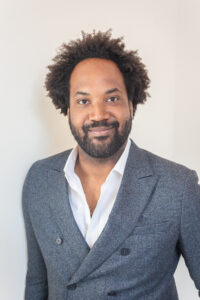 About Carl Baloney Jr. : Baloney has shared that this opportunity is not just the culmination of his professional experiences, but also a reflection of his deep-rooted passion for social justice and health equity, which is evident throughout his career achievements, and the realization of a lifelong commitment to justice, equity, and the health and well-being of the communities AIDS United serves. He often reflects on being raised in South Louisiana by a father who embodied service and resilience, and how these early lessons in justice and advocacy shaped his career trajectory.
As a Black gay man from the Deep South, Carl Baloney Jr., 40, is an advocate for policy solutions that improve the living and social conditions of disenfranchised communities, especially in the Southern region. In Baloney's early career, he served as a staffer in the U.S. House of Representatives for a Democrat from Louisiana and later as the senior manager of legislative affairs at Planned Parenthood Federation of America, where he cultivated partnerships with policymakers to support key issues, including expanding women’s health care coverage. In August 2015, Baloney joined AIDS United to lead its federal advocacy portfolio through strategic collaboration.
With nearly a quarter of his life dedicated to AIDS United, driven by a deep passion for health equity and social justice, Baloney led the development of the AIDS United Roadmap to Federal Action to End the HIV Epidemic, which laid the foundation for the federal Ending the Epidemic initiative. He also doubled the membership of the Public Policy Council to more than 60 organizations and modernized AIDSWatch, the nation’s oldest and only federal HIV advocacy event.
As a member of AIDS United's executive team, Baloney has mentored emerging policy and communication professionals at every level. His commitment to broader social justice is evident through his service on the boards of several organizations, including It Gets Better, the National HIV/AIDS Housing Coalition, Planned Parenthood Advocates for D.C/MD/VA and Global Black Gay Connect, where he helps advance health equity and uplift marginalized voices in diverse spaces. (Headshot of Carl Baloney Jr., Denis Largeron, 2024.)
AIDS United staff, the board of trustees and advisory council, and the Public Policy Council express their deep gratitude for Jesse Milan Jr.’s unwavering leadership and fully support the outcome of the succession process and the thoughtful transition of the president and CEO role. A celebration will be planned for a later date to honor Milan's tenure as president and CEO of AIDS United and his trailblazing legacy in the HIV movement.
For media inquires or question for AIDS United spokespersons, please contact AIDS United’s Communications Department at communications@aidsunited.org.
About AIDS United: AIDS United is committed to ending the HIV epidemic in the United States (U.S.) through strategic grantmaking, advocacy, and capacity building. Through our pillars of strategic grantmaking, capacity building and technical assistance, policy and advocacy. AIDS United has delivered more than $160 million in direct funding and leveraged an additional $184 million to increase the capacity of communities and organizations responding to the HIV epidemic across the U.S. Our grantees and members touch communities representing more than 96 percent of today’s HIV epidemic and we have proudly supported the work of over 600 organizations across 43 states, Washington, DC, Puerto Rico, and the U.S. Virgin Islands. Visit www.aidsunited.org to learn more about our work.
About Carl Baloney Jr. : Baloney has shared that this opportunity is not just the culmination of his professional experiences, but also a reflection of his deep-rooted passion for social justice and health equity, which is evident throughout his career achievements, and the realization of a lifelong commitment to justice, equity, and the health and well-being of the communities AIDS United serves. He often reflects on being raised in South Louisiana by a father who embodied service and resilience, and how these early lessons in justice and advocacy shaped his career trajectory.
As a Black gay man from the Deep South, Carl Baloney Jr., 40, is an advocate for policy solutions that improve the living and social conditions of disenfranchised communities, especially in the Southern region. In Baloney's early career, he served as a staffer in the U.S. House of Representatives for a Democrat from Louisiana and later as the senior manager of legislative affairs at Planned Parenthood Federation of America, where he cultivated partnerships with policymakers to support key issues, including expanding women’s health care coverage. In August 2015, Baloney joined AIDS United to lead its federal advocacy portfolio through strategic collaboration.
With nearly a quarter of his life dedicated to AIDS United, driven by a deep passion for health equity and social justice, Baloney led the development of the AIDS United Roadmap to Federal Action to End the HIV Epidemic, which laid the foundation for the federal Ending the Epidemic initiative. He also doubled the membership of the Public Policy Council to more than 60 organizations and modernized AIDSWatch, the nation’s oldest and only federal HIV advocacy event.
As a member of AIDS United's executive team, Baloney has mentored emerging policy and communication professionals at every level. His commitment to broader social justice is evident through his service on the boards of several organizations, including It Gets Better, the National HIV/AIDS Housing Coalition, Planned Parenthood Advocates for D.C/MD/VA and Global Black Gay Connect, where he helps advance health equity and uplift marginalized voices in diverse spaces. (Headshot of Carl Baloney Jr., Denis Largeron, 2024.)
AIDS United staff, the board of trustees and advisory council, and the Public Policy Council express their deep gratitude for Jesse Milan Jr.’s unwavering leadership and fully support the outcome of the succession process and the thoughtful transition of the president and CEO role. A celebration will be planned for a later date to honor Milan's tenure as president and CEO of AIDS United and his trailblazing legacy in the HIV movement.
For media inquires or question for AIDS United spokespersons, please contact AIDS United’s Communications Department at communications@aidsunited.org.
About AIDS United: AIDS United is committed to ending the HIV epidemic in the United States (U.S.) through strategic grantmaking, advocacy, and capacity building. Through our pillars of strategic grantmaking, capacity building and technical assistance, policy and advocacy. AIDS United has delivered more than $160 million in direct funding and leveraged an additional $184 million to increase the capacity of communities and organizations responding to the HIV epidemic across the U.S. Our grantees and members touch communities representing more than 96 percent of today’s HIV epidemic and we have proudly supported the work of over 600 organizations across 43 states, Washington, DC, Puerto Rico, and the U.S. Virgin Islands. Visit www.aidsunited.org to learn more about our work. Last month, we witnessed a peaceful yet surprising transition of power from the Biden administration to the Trump administration. The introduction of executive actions sparked steady frustration and fury about what would come next. Now, faced with navigating administrative uncertainty, HIV/AIDS advo
As we observe National HIV/AIDS Awareness Month and Black History Month this February, we are reminded that our fight is not just for access to life-saving medicines or groundbreaking policies—it’s for the rights, freedom, and dignity of every person, regardless of their HIV status. This month, AIDS
 As we observe National HIV/AIDS Awareness Month and Black History Month this February, we are reminded that our fight is not just for access to life-saving medicines or groundbreaking policies—it’s for the rights, freedom, and dignity of every person, regardless of their HIV status. This month, AIDS United’s staff and board of trustees call on advocates, partners, and members to be anchored in the theme: Reigniting, Sustaining, and Strengthening Communities and Coalitions for the Fight of Our Lives.
At AIDS United, our mission to end the HIV epidemic in the U.S. is rooted in the principle “nothing about us without us.” We know that communities carry both struggle and resilience, and our work is dedicated to ensuring that every voice, including those from Black communities, LGBTQ individuals, and other marginalized groups, is heard and empowered.
At a time when health equity and human rights are under threat, our role as a national leader in building power and coalitions has never been more critical. From grassroots advocates to national social justice leaders, our initiatives—such as our 60-member Public Policy Council and AIDSWatch, the nation’s longest-standing federal HIV advocacy gathering, are uniting voices across racial, geographic, and political divides to demand change.
Today, we invite you to stand with us. Your support is vital to reigniting hope in communities nationwide, sustaining the momentum of our advocacy efforts, and strengthening the coalitions that drive lasting impact. With your generous donation, we can continue to fight at both federal and state levels—expanding access to critical care, challenging systemic inequities, and ensuring that every person’s dignity is upheld.
A meaningful contribution that helps fuels our work:
$50 can help mobilize grassroots advocates to meet with lawmakers at AIDSWatch.
$100 supports the development of policy briefs and advocacy resources to educate lawmakers.
$250+ strengthens coalition-building efforts that drive systemic change.
Please join us in the fight for our lives. Donate today and help us build a future where every community thrives, every voice is empowered, and the epidemic finally ends.
As we observe National HIV/AIDS Awareness Month and Black History Month this February, we are reminded that our fight is not just for access to life-saving medicines or groundbreaking policies—it’s for the rights, freedom, and dignity of every person, regardless of their HIV status. This month, AIDS United’s staff and board of trustees call on advocates, partners, and members to be anchored in the theme: Reigniting, Sustaining, and Strengthening Communities and Coalitions for the Fight of Our Lives.
At AIDS United, our mission to end the HIV epidemic in the U.S. is rooted in the principle “nothing about us without us.” We know that communities carry both struggle and resilience, and our work is dedicated to ensuring that every voice, including those from Black communities, LGBTQ individuals, and other marginalized groups, is heard and empowered.
At a time when health equity and human rights are under threat, our role as a national leader in building power and coalitions has never been more critical. From grassroots advocates to national social justice leaders, our initiatives—such as our 60-member Public Policy Council and AIDSWatch, the nation’s longest-standing federal HIV advocacy gathering, are uniting voices across racial, geographic, and political divides to demand change.
Today, we invite you to stand with us. Your support is vital to reigniting hope in communities nationwide, sustaining the momentum of our advocacy efforts, and strengthening the coalitions that drive lasting impact. With your generous donation, we can continue to fight at both federal and state levels—expanding access to critical care, challenging systemic inequities, and ensuring that every person’s dignity is upheld.
A meaningful contribution that helps fuels our work:
$50 can help mobilize grassroots advocates to meet with lawmakers at AIDSWatch.
$100 supports the development of policy briefs and advocacy resources to educate lawmakers.
$250+ strengthens coalition-building efforts that drive systemic change.
Please join us in the fight for our lives. Donate today and help us build a future where every community thrives, every voice is empowered, and the epidemic finally ends.This week marked a significant moment in our nation’s history as we witnessed the 60th inaugural ceremony, a symbol of democratic continuity, while simultaneously honoring the life and legacy of Rev. Dr. Martin Luther King Jr. Dr. King’s work serves as a powerful reminder that democracy and civic en
 This week marked a significant moment in our nation’s history as we witnessed the 60th inaugural ceremony, a symbol of democratic continuity, while simultaneously honoring the life and legacy of Rev. Dr. Martin Luther King Jr.
Dr. King’s work serves as a powerful reminder that democracy and civic engagement are inseparable. His unwavering commitment to justice and equality underscores the importance of grassroots organizing, peaceful protests, and persistent advocacy in driving transformative change.
As we reflect on Dr. King’s leadership, let us be inspired to carry forward his vision of a more equitable and just society. Now, more than ever, we must channel his spirit of activism and take action to ensure access, equality, and dignity for all.
AIDSWatch is important as we consider the impact of recent federal policy changes on diversity, equity, and inclusion (DEI) initiatives. These changes, which restrict essential support for marginalized communities and redefine gender classifications, threaten to undermine the progress made toward creating a fair and just society.
This week marked a significant moment in our nation’s history as we witnessed the 60th inaugural ceremony, a symbol of democratic continuity, while simultaneously honoring the life and legacy of Rev. Dr. Martin Luther King Jr.
Dr. King’s work serves as a powerful reminder that democracy and civic engagement are inseparable. His unwavering commitment to justice and equality underscores the importance of grassroots organizing, peaceful protests, and persistent advocacy in driving transformative change.
As we reflect on Dr. King’s leadership, let us be inspired to carry forward his vision of a more equitable and just society. Now, more than ever, we must channel his spirit of activism and take action to ensure access, equality, and dignity for all.
AIDSWatch is important as we consider the impact of recent federal policy changes on diversity, equity, and inclusion (DEI) initiatives. These changes, which restrict essential support for marginalized communities and redefine gender classifications, threaten to undermine the progress made toward creating a fair and just society.
 Watch a video message from AIDS United’s President & CEO, Jesse Milan Jr., as he calls on YOU to join us at AIDSWatch! Together, we can pursue Dr. King’s vision of justice and equity by working to ensure a future free from HIV and full of opportunity for all.
At AIDS United, we remain unwavering in our commitment to ending the HIV epidemic in the United States. This work is rooted in honoring the resilience and leadership of people living with HIV while advancing racial justice, gender equity, and equitable access to care and prevention.
Dr. King’s legacy reminds us that systemic inequities can only be addressed through collective action, compassion, and an unrelenting commitment to justice. Inspired by his life’s work, AIDS United will continue to collaborate with partners, advocates, and policymakers to support people living with and vulnerable to HIV, dismantle barriers to health equity, and advocate for transformative policies.
Just as Rev. Dr. Martin Luther King Jr. marched and spoke to the masses to secure justice and equality, we too will march through the halls of power to advocate for what is necessary to change the trajectory of the HIV epidemic.
Watch a video message from AIDS United’s President & CEO, Jesse Milan Jr., as he calls on YOU to join us at AIDSWatch! Together, we can pursue Dr. King’s vision of justice and equity by working to ensure a future free from HIV and full of opportunity for all.
At AIDS United, we remain unwavering in our commitment to ending the HIV epidemic in the United States. This work is rooted in honoring the resilience and leadership of people living with HIV while advancing racial justice, gender equity, and equitable access to care and prevention.
Dr. King’s legacy reminds us that systemic inequities can only be addressed through collective action, compassion, and an unrelenting commitment to justice. Inspired by his life’s work, AIDS United will continue to collaborate with partners, advocates, and policymakers to support people living with and vulnerable to HIV, dismantle barriers to health equity, and advocate for transformative policies.
Just as Rev. Dr. Martin Luther King Jr. marched and spoke to the masses to secure justice and equality, we too will march through the halls of power to advocate for what is necessary to change the trajectory of the HIV epidemic.In April 2024, AIDS United eagerly welcomed Francisco Ruiz to his new position as the director of the White House Office of National AIDS Policy (ONAP). Last Friday was Ruiz’s final day as the Director and while his departure from this role is met with great sorrow, we look forward to continuing the
In the upcoming days, we will welcome the new members of the 119th Congress all with varied backgrounds and experiences that will undoubtedly aid in our collective goal to end the HIV epidemic in the United States. The challenges we face in our journey to reach our goals are numerous, from attempts
In the upcoming days, we will welcome the new members of the 119th Congress all with varied backgrounds and experiences that will undoubtedly aid in our collective goal to end the HIV epidemic in the United States. The challenges we face in our journey to reach our goals are numerous, from attempts to cut federal and state HIV funding in the appropriations process to ensuring protections for the LGBTQ+ community and preventing further attacks on reproductive health care, we will certainly have our work cut out for us. This new class offers multiple opportunities for new partnerships and avenues to face these challenges head-on. Below we’ve outlined some promising partners in our efforts to end the epidemic:
Senate
In California, we are eager to work with Senator Adam Schiff whose background includes advocating for continued abortion access, introducing the 2021 PrEP Access Coverage Act, and championing the Centers for Medicare & Medicaid Services’ expansion of coverage and elimination of out-of-pocket costs for PrEP under medicare. Schiff’s continued efforts to lower the cost of medication and ensure equitable health access for people living with HIV are critical to our mission of ending the HIV epidemic.
Other new Senate members of note include Lisa Blunt Rochester from Delaware, who was the first Black woman to represent Delaware in the House of Representatives and now the Senate. In her time in office, Rochester has reintroduced the HIV Epidemic Loan-Repayment Program (HELP) alongside former Chair of the HIV Caucus Rep. Barbara Lee. Senator Rochester has also participated in congressional briefings for National Black HIV/AIDS Awareness Day.
Angela Alsobrooks was elected to represent Maryland in the Senate in the 2024 election, becoming the state’s first Black senator. Senator Alsobrooks has shown support for our communities in the past through her work as County Executive of Prince George's County, Maryland to expand health services for individuals living with and affected by HIV/AIDS.
House
In Alabama’s newly created 2nd district, we are eager to work with Rep. Shomari Figures, a former Obama administration aide and deputy chief of staff to Merrick Garland at the Department of Justice. Rep. Figures’ strong background in civil rights and his work in campaigns to expand access to quality healthcare is critical in ensuring that equitable access to lifesaving and quality of life-enhancing healthcare is available to all people living with and affected by HIV in the United States.
We are excited to see Rep. Julie Johnson, representing the 32nd district of Texas. Rep. Johnson will be the first openly LGBTQ+ person to represent Texas in Congress and has been a long-time champion for LGBTQ+ rights and women’s health care. As the representative for Texas’ 115th district, Rep. Johnson introduced HB 3058, which would eliminate the requirement for prior authorization of prescription medications used to treat HIV. The ability to quickly and affordably receive medication is integral to the health and wellness of people living with HIV.
New Jersey’s 10th district will also be making history as it has elected LaMonica McIver to represent its district. Rep. McIver is the youngest representative to be elected to represent New Jersey in the United States House of Representatives. Her priorities in the past have included investing in our healthcare infrastructure, placing a specific emphasis on culturally competent care and combatting discrimination in healthcare institutions. This is a battle still being fought by people living with HIV, and to ensure all people are able to receive quality healthcare regardless of race, age, gender identity or sexual orientation, we must continue combatting discrimination & HIV stigma in the healthcare settings. We are eager to continue fighting alongside Rep. McIver in this effort.
As AIDSWatch 2025 approaches we are eager to use this as an opportunity to educate and collaborate with many first-term legislators on the issues their constituencies face. With our members' support, we can all advance along in our goal to end the HIV epidemic in the United States.
AIDS United hosts HIV advocacy fireside chat: Insights from Carl Baloney Jr. and Robert Suttle January 7, 2025, Washington, D.C. – AIDS United is proud to announce the successful conclusion of the fireside chat, “The Future of HIV Advocacy: Visionary Pathways for the Next Administration,” fea

Ending the HIV epidemic in the United States through strategic grantmaking, capacity building, and policy advocacy.
© 2026 AIDS United. All rights reserved. A 501(c)(3) nonprofit organization. EIN: 52-1706646
 I’ve been living with HIV for more than 30 years. In the early 1990s, during an era overshadowed by fear, stigma, and silence about the epidemic, even knowing your status could lead to rejection by family, community, and healthcare providers.
As a transgender woman, accessing quality, affordable healthcare has always been a challenge. For many in my generation, healthcare simply wasn’t designed with us in mind. For too long, we were left out—misunderstood, misgendered, and dismissed. And yet, we persisted.
In the early 2000s, I witnessed a shift. We began to see more legislative allies at the state level, and places like San Francisco became leaders in pushing forward protections for our communities. I joined the Transgender Law Center in 2005 to help ensure that trans voices were part of that change.
One pivotal moment was the passage of the Insurance Non-Discrimination Act, which required healthcare services to be offered equitably across gender identities. It meant that services like OB-GYN care, often listed only under “women’s health,” had to be made visible and accessible for all people, regardless of how they identified. That single shift helped begin the dismantling of a system that had excluded so many of us for so long.
We were building a more balanced system. A system that prioritized HIV treatment, de-stigmatized care, and created space for people like me to not just survive, but to lead and thrive. Gender-affirming care, much like HIV care, is deeply personal and life-saving. When people can access the care they need, they are empowered to participate fully in society.
But even with all that progress, we know policy goals alone aren’t enough. We must continue holding lawmakers accountable—not just for promises made, but for the funding and protections that make our survival possible.
Allyship is more than showing up. It’s not about saving us.
We aren’t waiting for heroes. What we need are co-conspirators—people who see us, listen to us, and follow our lead. Allyship means sharing the mic, shifting the spotlight, and helping to amplify the lived experiences of people most impacted.
We must not allow our progress to be pushed backward. We’ve come too far to return to a time when services were inaccessible, when trans people didn’t trust providers, and when a diagnosis was treated like a death sentence. When people try to take away that progress, they’re also taking away our hope. And without hope, it becomes harder to fight.
We cannot depend solely on government funding. That’s a reality we must face. We need our communities—and our allies—to stand with us not just in action, but financially as well. To contribute. To commit. To show up and speak out.
This is a wake-up call.
We must exercise our civil rights. That means contacting our elected officials, urging them to protect the systems that keep us alive, and demanding that they not dismantle the safety nets we’ve fought so hard to build—programs like the Ryan White HIV/AIDS Program, Medicaid, and Medicare. These aren’t just policies. These are our lifelines.
In recent years, we’ve seen attempts to roll back protections, to end federal support, to silence conversations about race, gender, and equity. We’ve watched as trans healthcare and HIV funding become political battlegrounds. But we refuse to go back.
I want to continue being one of the voices that holds policymakers accountable. While we may hold ourselves to bold declarations like ending the HIV epidemic by 2030, we can’t get there if the administration continues to dismantle the support systems we need to reach that goal.
When you lead from lived experience, you speak with the voice of a movement. You’re not just telling your story—you’re honoring every story like yours. That’s what keeps me going. That’s why I fight. And that’s why I will always stand for justice, for health equity, and for hope.
Let’s continue to show up for each other, for our futures, and for a world where survival isn’t a fight, but a guarantee.
About the Author: Cecilia Chung, a transgender woman living openly with HIV and Senior Director of Strategic Initiatives and Evaluation of Transgender Law Center and a member of the Board of Trustees for AIDS United. Cecilia Chung is internationally recognized civil rights leader who advocates for HIV/AIDS awareness and care, LGBT equality, and social justice. Cecilia has been a vocal advocate for transgender women and people living with HIV. Learn more about Cecilia Chung work at https://www.ceciliachung.com/
I’ve been living with HIV for more than 30 years. In the early 1990s, during an era overshadowed by fear, stigma, and silence about the epidemic, even knowing your status could lead to rejection by family, community, and healthcare providers.
As a transgender woman, accessing quality, affordable healthcare has always been a challenge. For many in my generation, healthcare simply wasn’t designed with us in mind. For too long, we were left out—misunderstood, misgendered, and dismissed. And yet, we persisted.
In the early 2000s, I witnessed a shift. We began to see more legislative allies at the state level, and places like San Francisco became leaders in pushing forward protections for our communities. I joined the Transgender Law Center in 2005 to help ensure that trans voices were part of that change.
One pivotal moment was the passage of the Insurance Non-Discrimination Act, which required healthcare services to be offered equitably across gender identities. It meant that services like OB-GYN care, often listed only under “women’s health,” had to be made visible and accessible for all people, regardless of how they identified. That single shift helped begin the dismantling of a system that had excluded so many of us for so long.
We were building a more balanced system. A system that prioritized HIV treatment, de-stigmatized care, and created space for people like me to not just survive, but to lead and thrive. Gender-affirming care, much like HIV care, is deeply personal and life-saving. When people can access the care they need, they are empowered to participate fully in society.
But even with all that progress, we know policy goals alone aren’t enough. We must continue holding lawmakers accountable—not just for promises made, but for the funding and protections that make our survival possible.
Allyship is more than showing up. It’s not about saving us.
We aren’t waiting for heroes. What we need are co-conspirators—people who see us, listen to us, and follow our lead. Allyship means sharing the mic, shifting the spotlight, and helping to amplify the lived experiences of people most impacted.
We must not allow our progress to be pushed backward. We’ve come too far to return to a time when services were inaccessible, when trans people didn’t trust providers, and when a diagnosis was treated like a death sentence. When people try to take away that progress, they’re also taking away our hope. And without hope, it becomes harder to fight.
We cannot depend solely on government funding. That’s a reality we must face. We need our communities—and our allies—to stand with us not just in action, but financially as well. To contribute. To commit. To show up and speak out.
This is a wake-up call.
We must exercise our civil rights. That means contacting our elected officials, urging them to protect the systems that keep us alive, and demanding that they not dismantle the safety nets we’ve fought so hard to build—programs like the Ryan White HIV/AIDS Program, Medicaid, and Medicare. These aren’t just policies. These are our lifelines.
In recent years, we’ve seen attempts to roll back protections, to end federal support, to silence conversations about race, gender, and equity. We’ve watched as trans healthcare and HIV funding become political battlegrounds. But we refuse to go back.
I want to continue being one of the voices that holds policymakers accountable. While we may hold ourselves to bold declarations like ending the HIV epidemic by 2030, we can’t get there if the administration continues to dismantle the support systems we need to reach that goal.
When you lead from lived experience, you speak with the voice of a movement. You’re not just telling your story—you’re honoring every story like yours. That’s what keeps me going. That’s why I fight. And that’s why I will always stand for justice, for health equity, and for hope.
Let’s continue to show up for each other, for our futures, and for a world where survival isn’t a fight, but a guarantee.
About the Author: Cecilia Chung, a transgender woman living openly with HIV and Senior Director of Strategic Initiatives and Evaluation of Transgender Law Center and a member of the Board of Trustees for AIDS United. Cecilia Chung is internationally recognized civil rights leader who advocates for HIV/AIDS awareness and care, LGBT equality, and social justice. Cecilia has been a vocal advocate for transgender women and people living with HIV. Learn more about Cecilia Chung work at https://www.ceciliachung.com/